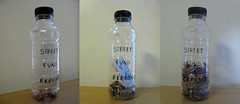
Trying out some arguments on public space, participation and collaboration of the audiences at Brno University of Technology, Faculty of Fine Arts.
The worst question I can ever be asked is: “You’re an artist! What type of art do you do?”, I can’t answer straight and I always seem to stutter. ...
And if public sphere, or public space was always connected to politics, or, lets say, it was a way of measuring the pulse of our democratic society, to attest its health, it seems to be less and less part of the political and philosophical discourse, as if of a cadavre we are talking about, and there is nothing much we can do about its situation, than just to forget.
“Participatory practices presumes that there is a difference between the producer and receiver, but the focus is on the latter, to whom a significant part of the development of the work is transferred”(Maria Lind, 2007)
"POWER2010 has entered the final few days of its public vote - where anyone can go online and vote for the changes they'd make to British democracy. Of the 29 ideas in the vote, themselves submitted by members of the public and then endorsed by a Deliberative Poll of a random selection of the population, only the top five come midnight on Monday will make the cut as a set of people's proposals for democratic renewal." quoted from opendemocracy.net POWER2010 enter site to vote
"Michael Landy transforms the South London Gallery into 'Art Bin', a container for the disposal of works of art. As people discard their art works the enormous 600m³ bin becomes, in Michael Landy’s words, “a monument to creative failure”. where to apply to discard your work
...thinking of CRISTIANA ROCHA's work when reading Agamben's comming community, specially the idea of the inessential character of the whatever singularity ... not that I fully understand why. In 2007 at the massive participatory even "Serralves em Festa", at Porto's contemporary art museum, Rocha invited the audience, according to some specific characteristic, to come together at a particular hour of the day at a particular time, and only them the commonality appeared... see more here
Democracy according to Aristotle and the Revolutionary Workers in Venezuela.
A society is called a State when it has a collective aim, and according to Aristotle it aims at the highest good, this good is of the State itself and not of each citizen’s as individual.
Naturally, thought Aristotle, this State shall have rulers and subjects and is to be governed in a way ‘where everyman can act best and live happily’. This happiness is bond to wisdom and not to material possessions, but to be wise one has to have leisure time and not be engaged in everyday life survival, therefore wise man must be provided with property. Here comes a vicious circle, those who are wise must be entrusted with property, those with property and free time will certainly be wiser. So property is again a condition to rule and in the end of the day Aristotle polity is an oligarchy.
Nowhere in his treatise Aristotle considers a State without rich and poor; even though he affirms that the best States are those where the middle class is the larger class; as a matter of fact it could be accepted – there have been always rich and poor, but is troubling when it is never questioned why are always the same getting the best gifts from Fortune, for it seems that there is not much class interchange in his treatise.
Education is paramount to Aristotle’s constitution, and it is a matter of the State; this reveals which instrument is used to maintain each player in its own position, for education is the same among equals but some are equals as possible rulers and others equal as permanent subjects. Aristotle will use a similar argument to Plato’s to differentiate natural rulers and natural subjects making an analogy with the anatomy of the soul where one part – rational – naturally rules and the other – irrational – is ruled. Again why some are soul and others body is difficult to accept as natural.
Now, let the citizens rule! But what is a citizen? A citizen is not an individual who lives in a certain State, he is the one who takes part of the government of the State; and the constitution will be different if this government is in the hand of one, or of few, or of many; and of course governing to the common interest otherwise they are perversions. The best constitutions are then, according to Aristotle, kingship, aristocracy and polity or simply constitution, which is a ‘fusion between oligarchy and democracy, inclining towards democracy in an attempt to unite the freedom of the poor and the wealth of the rich.’
In practice there are only two types of government: oligarchies and democracies, both perversions, or imperfect constitutions. A form of government is a democracy when the free, who are also poor and the majority govern, and an oligarchy when the rich, being few, rule. Focusing only on Aristotle notion of democracy, we find that it arises out of a revolution based on ‘the notion that those who are equal in any respect are equal in all respects; because men are equally free, they claim to be absolutely equal.’ With which he disagrees, because men are rarely absolutely equal, the simple fact of being young or old, he would argue, differentiate men. And because a democracy governs towards the interests of the majority and not of the common is, therefore, a perversion.
Nonetheless the main characteristics of democracy, for Aristotle, are: ‘the election of officers by all out of all; and that all should rule over each, and each in his turn over all’; the appointment to every office is made by lot; the possession of property should not be required for offices; no one should hold an office twice, and this tenure should be brief; all men should judge, in all matters, or in the most important; the assembly should be supreme over all causes, or the most important. This highest type of democracy is based strictly on equality, rich and poor have the same right to hold office and the multitude has supreme power. But because it is the highest it is also the worst type.
As a counterbalance I propose a look at 5 Factories, the 2006 documentary by Dario Azzellini and Oliver Ressler about five self-managed factories in Venezuela, which seems to show that a democratic rule is possible. After the Bolivarian Revolution (term coined by the Venezuelan president Hugo Chavez to refer to the social movement, or twenty first century socialism in South-America) many workers in Venezuela took charge of factories that they had worked on and had been closed down by their former administrators as ruined and led them to full operational plants. Organized in cooperatives, the five examples given in this documentary portray a different way of managing a company, a social administration way. Taking the example of the presented CAIGUA tomato sauce factory, which won a government subsidy - already during Chavez legislation – to invest in modern equipment and enlarge the range of products, but which subsidy was diverted for personal expenses, I will demonstrate how a democratic management is done. The workers, realizing, that the factory was working only at 10% of its maximum capability, due to lack of raw material but specially due to ill administration, saw in the misuse of the government’s subsidy and the lack of payment the excuse they were looking for to take the management of the plant in their hands. Occupying the factory day and night over three months, they prevented the former administration to enter the facilities. Encouraged by Chavez government they constituted a cooperative, that gives shape to their social struggles. Part of this different way of managing a company, which is directed towards the benefits of the whole community and not only of the company itself, CAIGUA helped the local producers with machinery in order to augment the producing of their raw material, tomatoes. The company is managed by a temporary board of directors, selected from the body of workers, which works closely with the assembly all, 58, workers. All the projects and decisions pass by this assembly where all the opinions count. It seems only possible because there is such a small body of workers, critics of democracy would argue; but in another example presented in this documentary, an aluminium plant, the same management is being done with 3200 workers. Part of the success of these co-managed companies is due to the fact that all workers are informed of all the procedures necessary for the company’s production and management; that all workers are involved in all decisions and also because part of this type of cooperative administration involves a social-political engagement and education. At CAIGUA all workers earn the same salary, being administrators, technicians, or operators; and the surplus is distributed between the community by supporting education centres, medical care or opening their canteen tho the most needed. The aim of a democratic state, Aristotle would say, is liberty. Listening to these workers one can understand this idea of liberty, of not being constrained to express one’s opinion and ideas regarding the management of the common, but they are also aware that it does not mean simply licence - as described by many democratic critics.
The danger for Aristotle is that in democracy ‘the people becomes a monarch’, which grows into despotism. The best democracy, for him, would then be that which is subject to the law. The multitude is not call to decide upon every matter, specially the most important, for those would be in the hands of the magistrates; and the best citizens are in charge, so the more qualified represent the uninformed.
Yet, we realize in this documentary that when a worker feels that his opinion counts; that the company also belongs to him and that the result of his labour will benefit not the company and its few owners but himself and his community; he will be engaged in aiming at that Aristotelian highestgood, which is not the good only of himself but of the community, and ultimately he is HAPPY.
Aristotle, 1921, The Works of Aristotle, Oxford, Clarendon Press Azzellini, D. and Ressler, O. 2006. 5 Factories. [DVD].
Twitted by GRAVANA: "Camera aboard a NASA spacecraft orbiting Mars will soon be taking photo suggestions from the public http://ow.ly/YU4x"
It reminds me of an overheard comment on how fashionable participation is nowadays, from televote to educational services in museums ... to NASA. With no sarcasm I say, when not mandatory there is something really powerfull about participation ...
"Since arriving at Mars in 2006, the High Resolution Imaging Science Experiment, or HiRISE, camera on NASA's Mars Reconnaissance Orbiter has recorded nearly 13,000 observations of the Red Planet's terrain. Each image covers dozens of square miles and reveals details as small as a desk. Now, anyone can nominate sites for pictures. ... The idea to take suggestions from the public follows through on the original concept of the HiRISE instrument, when its planners nicknamed it "the people's camera." The team anticipates that more people will become interested in exploring the Red Planet, while their suggestions for imaging targets will increase the camera's already bountiful science return. Despite the thousands of pictures already taken, less than 1 percent of the Martian surface has been imaged." see the rest of the article here http://ow.ly/YU4x
Participants will not be just anyone, for the suggestions are sellected 'based on science rationale', it is, therefore, targeted to science students and professionals. I have created my account but since I could not provide any further rationale then curiosity I won't be able to suggest any target for NASA's camera nor receive my own picture of Mars terrain, oh well, "public" is only universal in theory anyway!
Is it the question of maintaining a public sphere the question of the possibility of democracy?
ORWELL: Political purpose - using the word "political" in the widest possible sense - the desire to push the world in a direction, to change other people's ideas about the type of society for which they should fight. (2008, 17)
I have always defended artistic intervention in public space, for the defense of a participated public sphere, therefore democratic and this is my political purpose. But what is public sphere or even democracy and its relationship with art it is still to be understand, and what I share here is just the beginning of a search. Neither the fabric is woven, or the loom ridden, but only the warp preparation is being done.
The bourgeois public sphere, which Habermans gives account of its disintegration in the The Structural Transformation of the Public Sphere, was a the late eighteenth century sphere of private individuals gathered as a public and thus controlling public authority. This enlightened public use of reason was not only the courage to think for ourselves, but to do it aloud, and is seen as the paradise lost, but with the mixture of state and society in the late nineteenth and early twentieth century a 'public sphere has lost its political function, namely: that of subjecting the affairs that it had made public to the control of a critical public.’
Salons disappeared, in the course of twentieth century, the leisure activities of culture-consuming public replace them, but these new activities do not require any critical discussion. The diagnosis was that the discussion has become a mere exchange of tastes and preferences among consumers since the occupation of the public sphere by the dispossessed masses, which led to an interlocking of state and society that has demolished the old foundation of that sphere without supplying a new one.
The importance of a critical public sphere in connecting society with the state seems still paramount to democratic theory, therefore many defend its rehabilitation, but is there only one public sphere, or are they multiple?
HANNULA: The idea of an open public sphere, where so the story goes, all interested parties can collaborate and exchange ideas equally is a beautiful dream, but not much more that that. Public space is a tool of control, and a tool for achieving certain ends. (2006, 74)
Let’s admit the plurality of public spheres – but Habermas considers only a democratic public sphere, which does not coincide with the public spheres of mass culture, is one and only one in which citizens could communicate about the regulation of public affairs.’
Unlike Habermas the Viennese philosopher Marchart opposes to this idea that the democratic public sphere 'is naturally privileged over others’. He asks, ‘what makes all the various "partial" public spheres such as the everyday public spheres of advertising, backstairs gossip, sports events, youth cultures, etc. any less public, less autonomous or less universal than a public sphere created through rational discussion.’
LACLAU: For me, a radically democratic society is one in which a plurality of public spaces constituted around specific issues and demands, and strictly autonomous of each other, instils in its members a civic sense which is a central ingredient of their identity as individuals. Despite the plurality of these spaces, or, rather, as a consequence of it, a diffuse democratic culture is created, which gives the community its specific identity. Within this community, the liberal institutions - parliament, elections, divisions of power - are maintained, but these are one public space, not the public space.
Mouffe would follow saying that despite this plurality democracy does not consist of a colorful harlequin suit of public spheres, ‘rather the conflict of the question as to which public spheres are tolerated as politically legitimate and which are not’. This is the notion of an agonist democracy where different groups will be in permanent conflict, not as enemies but as competitors. Public sphere emerges where is dissent since homogeneity is an illusion and consent an impossibility. What Mouffe proposes, therefore, is a continuous and permanent agonist conflict, that instead of trying to eliminate power relations brings them to the fore to be disputed. The possibility of democracy lies also there where a constant articulation and re-articulation of alliances, or temporary consensus is made.
HANNULA: We are part of the game, part of the mess. What we ought to strive for is the perspective of a critical reflective participant... (2006, 76)
In what sense can art – and we shall say public, including performance which is the reason for this ‘warping’ – be a part of this ever-present attempt ceaseless attempt to build a public sphere and hence society?
BEGGAR: you have nothing to do with it. Now you have your chest hollow, like a hole in the sewer, because you made a stupid question. They are all stupid questions. What stupidity, questions! *
So lets untangle the skein from another end. Democracy for Plato was not only a form of government, but the third degree of the good government’s decay. The democrat, son of the oligarch, blind due to excessive freedom: for him everything is the same, good and bad, everyone is entitled to equal civic participation, liberty and equality is his motto. Jusque ici tout va bien. But it is not the fall but the landing that is matters, and according to Plato all that is excessive comes back as its opposite. The destruction of democracy, he announces, will be by the metamorphosis of its highest good - freedom - into its opposite: excessive slavery, and with it tyranny.
By this diapason the contemporary critics of democracy tune their repertoire, portraying democracy as the destroyer of the social body due to its excessive individualism – the search for personal pleasures and material prosperity - which in turn is seen as the antidote since time Aristotle’s time of that which is fatal to democracy and which reveals the known democratic paradox: the excess of democratic activity is the ruin of democracy and therefore should be repressed. In turn this repression leaves citizens indifferent to the common good and undermine the state’s authority. Good government, as Rancière affirms, shall be that which is capable of balancing this excess of collective activity and individual withdrawal inherent to democratic life.
RANCIÈRE: democracy is the worst of governments with the exception of all the others. (2006, 4)
Being able to rule or be ruled is an aphorism dear to the good government of Plato - where the most stronger and wise were the guardians of the city - but it is also exactly where democracy turns out to be problematic. The real scandal, Rancière would say, is not in the excessive demand for individual pleasure but in the superiority to rule be based on nothing more than the absence of superiority, i.e., the guardians would be chosen by drawing of lots.
Politics begins exactly there, where the power of birth is undermined and declared for what it is, the power of the property-owners. Democracy is precisely this dissociation and not a kind of constitution, or a type of society. The power of the people is not the union nor the power of the majority but the very particular power of those who have no more right to govern than to be submit, which is then the power of anyone, and everyone.
The public sphere, as stated above, shall be in constant conflict, just as democracy must fight continuously against the distribution of public and private under the control of oligarchs, and also, as Rancière says, ‘struggle for the enlarging of the recognition, as equals and as political subjects, of those that have been relegated by State law to the private life of inferior beings, and to assert the public character of spaces, relations and institutions regarded as private.' It will then be in the small gestures of emancipated political subjects that democracy operates.
* In The Begger or the Dead Dog. 1919. Bertolt Brecht
HABERMAS, J. 1989. The Structural Transformation of the Public Sphere: an Inquiry into a Category of Bourgeois Society. Polity Press.
HANNULA, M. 2006. The Politics of Small Gestures: Chances and Challenges for Contemporary Art, art-ist.
MARCHART, O. 1999 . Art, Space and the Public Sphere(s). [Online] disponível em http://www.eipcp.net/transversal/0102/marchart/en [Acedido a 14 Novembro 2009]
MOUFFE, C. 2000. The Democratic Paradox. London, New York: Verso.
ORWELL, G. 2008. Por Que Escrevo e Outros Ensaios. Antígona.
PLATO. 1997. Republic. Wordsworth.
RANCIÈRE, J. 2006. Hatred of Democracy. Verso.
HARUN FAROCKI Against what? Against whom? image source
4. Transmission, 2007. Video, 1 screen, 43 minutes. "Transmission was a public art commission in Zurich, designed originally as a loop for projection outside a bus station. Its subject is the memorial stone, a site where memory seems permanently fixed"
Transmission. Why do people want to connect to something, touch and be touched? Have I touched St. Peter’s foot in Rome? I don’t recall doing so, but I do remember perfectly realizing the power of a single touch. There is a saying in Portuguese that the continuing dripping of soft water in hard stone will eventually open a hole. Maybe that was what went through my mind, and if I touched the saint’s foot was not so much with the desire to connect with the divine but with that mass of people who repeated a gesture over and over until the metal foot became soft, polished and shapeless. That would be for me the morbid allure, being part of an endless chain. The power of the repetition of an act. But this is not the metaphor for the power of the people, the one that destroys social constructions, rather is the repetition leading to meaninglessness. Rancière knew that already when we saw in the power of the people not the power of the population or of the majority, ‘but the power of anyone at all’.
The power of subjectification, of becoming a subject of politics, which is always something ‘defined in an interval between identities.’ (Rancière, 2006, 59) between different names of subjects. That’s when politics occurs, and like the women that in 1955 refuse to leave the white people’s seat in an Alabama bus, politics implies: ‘the action of subjects who, by working the interval between identities, reconfigure the distributions of the public and the private, the universal and the particular,’ that are fixed by models of government and practices of authority i.e., by police.
These repetitions in Rome, Jerusalem, Santiago de Compostela, and Munich are full of hope and so are our votes in each and every election, which lead to a change of flavor but do not a new aliment. Rancière will call it an oligarchic invention to look for consent, and the representative democracy portrayed as only representing the interest of an elite. Universal suffrage is not a natural consequence of democracy, he will further, it is its struggle, the democractic struggle against the privatization of the process of enlarging the sphere of State intervention. Pursuing ‘the recognition, as equals and as political subjects those that have been relegated by State law to the private life of inferior beings – wage workers and women;’ and ‘the recognition of the public character of types of spaces and relations that were left to the discretion of the power of wealth;’ (Rancière, 2005, 55) and finally the enlargement of the struggles to ‘assert the public character of spaces, relations and institutions regarded as private.’ (Rancière, 2006, 56)
This redistribution of spheres and the subjectification inherent to it is paramount to Rancière’s maintenance of democracy, or is where democracy actually operates, and understanding what democracy is means renouncing to a vision of a world governed by the multitude and trust it to those singular and precarious acts on political subjects.
'We are accustomed to hearing that democracy is the worst of governments with the exception of all the others.' (Ranciére, 2006, 4)
Democracy has been hated since ancient times as a perversion of the good government due to the excess of license which with intensive participation ruins the state; this has been re-directed to the search of material prosperity and private pleasures which results on citizen’s indifference towards the common good and the weakening of public authority. So if not by the illness death comes by the cure.
The diagnosis is identical today, people are disengaged from politics, and if politics is, as in ancient times, the search for the common good, and today’s citizen is the individual consumer pursuing his private affairs we can see how democracy was reduced to a mere form of society emptied from politics, and seen as a corruption of it’s people and not of its government.
Who is entitled to govern has always been the question in search of the good government and it is where democracy, states Rancière, reveals the trouble. Plato lists seven titles to govern; four related to birth: being older, or the father, highborn, free; and two associated to relations in nature: stronger over the weaker, wiser over the ignorant. The first four, base government of kinship; the latter two on excellence, and according to Rancière it is where politics commences, when the title to govern is separated from kinship, and also when the seventh title appears – the drawing of lots – the title of chance, the democratic title which is no title. And that is what is so outrageous for some people: that age, birth or even wisdom has to ‘bow before the law of chance.’
Then, if politics begins when the power of birth is undermined and its true nature disclosed – property-owning power – democracy creates a rupture relegating to different places the principle of government and the principle of society, and this dissociation is its ultimate meaning: ‘the primary limitation of the power of forms of authority that govern the social body.’ (45) And for Rancière ‘if politics means anything it means something that is added to the possible governments’, that naturally are oligarchic, ‘and put themselves forward as models for the construction of larger an more complex human communities.’ (45) This something is democracy, the government of chance. So in his view democracy is neither a type of constitution nor a form of society, ‘but is this ungovernable on which every government must ultimately find out it is based.’ (49) The condition to have a political government, thus, is to be founded on the absence of title to govern, and politics exists only if there is a supplementary title, and again the scandal of democracy, is that this title is the absence of title; the power of anyone at all. So at the bottom of every government is equality, for inequality cannot exist without a ‘multitude of egalitarian relations’.
Democracy has been confused with representative democracy, but lets not be fooled says Rancière, ‘representation was never a system invented to compensate for the growth of population’ it represents the property owning minorities ‘who are entitled to take charge of public affairs.’ But again democracy is not a type of constitution; it can never be identified with a juridico-political form. It is the power of the people – not of the majority but of anyone and everyone – and this power works beneath the state, because of its egalitarian foundation; and beyond the state, because its public activity frustrate the ‘State’s tendency to monopolize and depoliticize the public sphere’. The State’s tendency is to shrink this public sphere , by relegating the interventions of the citizen’s to the private domain; democracy fights this tendency in the endless effort to enlarge this sphere. This struggle is then about distribution, a key concept in Rancière’s thought, the ‘distribution of the public and the private that shores up the twofold domination of the oligarchy in the State and in society’. This re-distribution is a struggle to: defend the ‘public character of spaces, relations and institutions regarded as private’ (56); recognize ‘the public character of types of spaces and relations that were left to the discretion of the power of wealth;’ (55) by doing so it enlarges the ‘recognition, as equals and as political subjects those who have been relegated by the State law to the private life of inferior beings.’
The idea of becoming a political subject is also paramount to Rancière’s thought; are man and citizen the same subject? Rancière unpacks this question through Hannah Arendt and Karl Marx notion of Human Rights. To the first these are the rights of bare life, of those who do not belong to any constitutional national community, therefore without rights, so the Human Rights are an illusion; to the latter these are the rights of citizens, property owners who belong to a national community, therefore the rights of those who have rights. But to Rancière they both miss that the one of politics exists only through that supplement which is democracy. Neither bare life, nor citizenship of constitutional texts are political subjects, these are always defined by an interval between identities, when the distribution of terms and places are overturned.
Rancière uses the statement of Olympe Gouges to further this idea: 'Woman has the right to mount the scaffold; she must equally have the right to mount the rostrum', i.e., if she can be sentenced to death then she does not belong solely to the domestic life. ‘Women can therefore claim rights as women and as citizens, an identical right that, however, can only be asserted in the form of the supplement.’ (60) Gouges, maintains Rancière, proved wrong both Arendt’s and Marx’s views. She ‘inserted a third possibility: women's and citizen's rights are the rights of those who have not the rights that they have and have the rights that they have not.’ (61) They are deprived of the rights but at the same time they exercise them. Politics is that operation of splitting into two – which he illustrates with the example of the women that in 1955 refused to leave the white people’s seat in an Alabama bus. ‘That is what the democratic process implies: the action of subjects who, by working the interval between identities, reconfigure the distributions of the public and the private, the universal and the particular.’ Democracy must constantly bring into ‘play, inventions of forms of subjectivation and of cases of verification that counteract the perpetual privatization of public life, in a ‘political movement that blurs both the given distribution of the individuals and the collective, and the accepted boundary of the political and the social.’
Ranciére call us to renounce to the faith in the vision of democracy by the multitude, which is such a dreadful task; but if we understand democracy’s true meaning, that an ‘egalitarian society is only ever the set of egalitarian relations that are traced here and now through singular and precarious acts,’ (96) and that ‘it is only entrusted to the constancy of its specific acts,’ then, as he finishes ‘to those who know how to share with anybody and everybody the equal power of intelligence,’ democracy can ‘inspire courage, and hence joy.’ (97)
Participation in, and the construction of, democracy, according to Rancière, is then to act in the intervals of our own identity split and therefore fight the state’s privatization of our private life with single and precarious gestures of equality.
Which kind of participation is possible in Plato's aristocracy?
In his book Republic, Plato supposedly transcribes a conversation between Socrates and some young Athenians that starts by analysing what is justice leading to the creation of a just city. This ideal city follows – what was identified by Leon Battista Alberti during the Renaissance as – concinnitas universarum partium, or the harmony and concord in all the parts in relation to one another, where each and every organ mind its own performance and to remove one part compromises the whole. Being on one’s place is here proved to be the required participation in this city. Divided in four elements: wisdom, bravery, temperance and justice; Socrates will analyse the city’s first three elements believing that the remainder would be justice, the gathering’s inquire. As the appetite is the largest element in an individual, followed by courage and both governed by his reason, the smallest element; so is the city ruled by a few wise men and women or by a king with a true love for philosophy, helped by soldiers and a larger amount of auxiliaries. Each element does it occupation, that should be a single one if to be done with excellence, and respect the rule of the few and this harmony and respect to the wise element is what makes a man or a city just. To be sure, in such a city to be a just man means performing the assign task, be it to be a shoemaker or a philosopher, according to one’s gifts and training; and this is the required participation, to be just.
Why then, have I been dreaming about the reasons to escape Plato's perfect city and fall into the extravagant excesses of a democracy? For I truly have.
Until the city is ruled by philosophers there shall be no constitution worth being called a city, under this oath Socrates debates on the reasons why philosophers are considered useless by the multitude and nevertheless are the right ones for the job. The reason being that philosophers are the ones with access to the essential forms lighten by good and revealed by pure reason. To achieve this level of knowledge requires years of training in several subjects and to be considered as guardians requires a just city. Democracy for him is not a just constitution but the third level of decay from the desired one, aristocracy. An oligarch’s son, the democrat is blinded by license; all appetites are alike for him, good and evil; everyone has equal participation in civic right, liberty and equality is his motto. Jusque ici tout va bien. However it is not the fall but the landing that matters, and as is noticed in their conversation to do anything in excess seldom fails to provoke a violent reaction to the opposite extreme. Democracy destruction shall be by the metamorphosis of the object of its supreme good – freedom, into its worse shape: excessive slavery, and with this tiranny arises.
This hate of democracy is as old as its very origin, ancient Greece. And today’s hate formula is not against democracy itself, conversely to Plato’s idea, democracy is not a corrupt form of government, the problem is about the people, democratic civilization. What provokes the crisis of democracy is nothing other that the intensity of democratic life (Ranciére, 2006, 7).
PLATO. 1997. Republic. Wordsworth. RANCIÉRE, J. 2006. Hatred of Democracy. Verso.
continued on note #13 with the reading of Ranciére's Hatred of Democracy…
A performance done in October 2009 at Avenida dos Aliados, Praça da Liberdade and Largo dos Lóios - Porto by the name Coreto. An ephemeral piece made out of cardboard that echos those structures of Porto's Romantic gardens, once filled with the music of local brass bands are nowadays quite abandoned. This intervention was made in the context of an educational project - Artistic Interventions in Public Spaces and Site Specific work - by André Silva, Cláudia Lopes, Dalila Gonçalves and Inês Gama.
It seems that the bandstand had a programme with music and that interaction was the goal. Unfortunately I could not see if there was any, and of what kind. The truth is that this Avenue after being requalified three years ago have been the target of several artistic interventions that try a posteriori to inquire what has not been examined before the urban intervention: what was it used for and what can it be used for on an everyday basis.
(5th attempt, and certaintly not the last, to clarify my research)
Art, as politics, pose questions of responsibility about our role in society (1) and a politicized art can be part of the toolkit of the radical and plural democratic project (Mouffe, 2009). Democracy should be under constant revision, and the role of one and each citizen is paramount to the maintenance of its project, or it is not. Notions of participation and resistance are then an important aspect for this maintenance. My affiliation would be to art that call to arms and inspire people to take action but the contemporary discourse seems to be much more directed towards passive resistance. This led me to think of the political gesture of Michael Angelo’s David and Agamben notion of passive resistance seen through Melville’s character Bartleby who “would prefer not to” (2) , as different examples of resistance. On the one hand a call for an active participation on the other a call for inaction as strategies of defeating hegemonic systems. Being the first utopian, ideological and outdated and the latter conforming to the Zeitgeist and offering potential effect. This poses a problem to my own position as a possible conservative one (in the sense of maintaining old left-wing pro active strategies), and how to understand this idea of participation through non-participation, which I visceral refuse. But why? is it because I want to hold on to outdated ideals? Or is there really something counter-productive leading to global inaction on theorising around refusal as a positivist resistance position?
So what is at stake is active/passive resistance, participative participation and non-participative participation. Is one excluding the other? Believing that the latter does really have a potential for change, and is the strategy to follow, what would happen if we would just ALL disengage? We should not forget that Melville’s Bartleby dies in the end. Does this mean that the opposite it true, that the participation of ALL is ultimately ineffective? If active participation might help the formation of collectives is refusal individualistic? Is this a matter of which has stronger agency? I was before holding on to the idea of the small gesture , as a dear one, but is the small gesture (3) actually a refusal of participating in grand visible projects?
Kris Cohen gave –in the lecture “atmospheres of participation”– the Tutti Bianchi squad as an example of refusal. The Tutti Bianchi operates on the G8 summits as a heavily padded group of people under white overalls that conduct a kind of Gandhi resistance. Staying in front of the mass of demonstrators they take the blows of the riot police without being hurt. I argue that this is not exactly a sit in protest, they prepare themselves in advance and do attempt to progress in the confront field to win territory and by doing so affirming the eligibility of demonstrating and how the local governments have been pushing this protests further and further from the actual location of the meetings (4). But if this extraordinary form of resistance is truly a Bartlebian one, what does this make of my argument of these being different types of participation? But is it really, or are theorists just pushing it a bit to far?
1 ( Bernadette Buckley lectures in art and politics helped to articulation this idea) 2 ( A month of lectures and reading led me to this feeling of a contemporary celebration of inaction, failure, non reciprocity, indifference, doing wrong as active modes of expressing dissactisfaction and therefore sites of resistance.) 3 (Hannula, M. (2006) the Politics of Small Gestures – Chances and Challenges for Contemporary Art, Art-ist) 4 ( I owe this notion to Oliver Ressler)
Signs of RevoltBricklane 91 - Shop 14 / truman Brewery - London
Brian Holmes write on the catalogue that "all of the activists-artists in this exhibition, and probably most of the visitors as weel, took part somehow in the inspiring and dramatic events created by the movement of movements - events that started well before Seatle, for example at the Carnival against Capital in the city of London on June 18th 1999, or at any one of the surprising and often hilarious Reclaim the Streets parties... some of us will meet again and again beneath the teargas and water canons ... only to learn that the leader of our supposedly democratic countries cared nothing for the votes that were cast in the streets." meaning that new forms of protest have to be experimented?
View of the exhibition
Holmes also wrote about the role of art as offering a "foretaste of a better life" but also an incompleteness, which means "an invitation to participate ... the art of the protest movements mingles dream and reality, beauty and terror, and expresses a symbolic violence of a necessary break with society as it is, while never forgetting that the real violence continues."
"the decade to come will see the most passionate struggle of them all: the one that finally takes apart the neoliberal system, to invent a future that no one claims to own and that no one trades away for profit, a future that everybody can live with." and I would argue that this struggle has to be fought on everyday life and maybe it is through this scope that the 3 years art project of Sarah Cole in a primary school takes its most radical democractic patine NEST LIFE
The Library of Secrets is a mobile library conceived from the love of keeping and finding things amongst the pages of books. The Library of Secrets invites you to leave your thoughts, wisdoms and secrets amongst the pages of one or more of the 400 books in its collection. Peruse the shelves for your favourite 19th or 20th century classic or maybe just rummage through the books to find other peoples secrets.
Between 2007-2008 The Library took up residence in different venues across Whitstable as part of Whitstable Biennale 2008. For a whole year the The Library of Secrets hosted a series of events including the Book Club Debate, which met every 6 weeks. The Book Club focused on discussing books that inspired the films Peter Cushing starred in, including; Dracula, Lolita, The Hound of the Baskerville’s, Frankenstein, Nineteen Eighty Four and The End of the Affair. These classics are often imbedded in our knowledge through their film adaptation rather than the original novel. The Book Club Debates were chaired by myself and a host of visiting experts, lively debate was followed by a screening of the film each book inspired. The Book Club Debate was documented through a series of book reviews written by myself and members of the Book Club.
The Library of Secrets also became a mini publishing house producing a series of artist’s books that chart the development of the library and its relationship with its members. The books and multiples that have been produced include, ‘The Book Club Debate Whitstable’, ‘The Writing Challenge’ and ‘Things Found Inside Books’.
I attended the Real Wold Seminar at the Whitechapel, and this was how I got to know Serena's work. A work that according to Serena's own words seeks to intervene in everyday life, to disrupt everyday. One of the things that interest her the most is story telling, other people's stories, things you don't find in books, but in this piece the audience does find those bits and pieces of people's life inside books, for she invited the audience to leave secrets in between the pages of the many books on tour. Working with people is the other big interest in her work, to ask for collaboration on the very creative process, as for example in the answers lies at the end of the line for the Tube, local crossword puzzle fanatics were invited to help her create puzzles to be distributed across the Jubilee line.