Sunday, May 16, 2010

demoCRACIA


THE UNSURPASSABLE HORIZON
A project by Filipa Oliveira + Miguel Amado
No Soul for Sale – A Festival of Independents at Tate Modern, London

No Soul For Sale – A Festival of Independents
May 14 – 16, 2010
10 AM – 12 PM (May 16: 6 PM)

www.nosoulforsale.com


Lisbon, May 10 – The Lisbon-based curatorial collective Filipa Oliveira + Miguel Amado is presenting “The Unsurpassable Horizon”, a project organized for NO SOUL FOR SALE – A Festival of Independents at Tate Modern, London. This project brings together works by Carla Cruz, Ruth Ewan, Runo Lagomarsino, and Lotte Lindner & Till Steinbrenner. The works on view respond to, comment, and speculate on the potential of the communitarian ideal in contemporary society. This project thus addresses the social fabric in which both artists and non-profit organizations/curatorial collectives operate, considering consider the public sphere as an arena of individual participation in the collective future.

In one of the most acknowledged books by the French philosopher Jean-Luc Nancy, The Inoperable Community (1982), he sets himself the task of redefining community beyond a cultural, economic and political dimension. To be operative, the community needs a substance, a sense of communion, and this is the intellectual framework that shapes “The Unsurpassable Horizon”. These artists deal with community as something that either has been disintegrated or that is in a process of rebuilding. Their practice thus reflects the entropic current state of affairs that Nancy encapsulates with his reference to the contemporary “unsurpassable horizon” of political, economic, and cultural regimes.


Cruz’s demoCRACY (2010) consists of a typical voting scene: a ballot box and two piles of ballots on each side of it. The ballots have a question addressed to the potential voter: “Would You Like To Participate?” Three possible answers are given: “Yes”; “No”; and “None of The Above”. What is not made clear is on what the viewer would be voting on. In addition, there are no pens available and the ballot box doesn’t even have a slot where one could insert the ballot. Alluding to the mixed feelings of hopelessness expectation of change through the electoral process, the artist examines issues of civic participation and citizenship in liberal democracies.


Ewan presents a series of drawings created between 2006 and 2009 that are available as stickers sold at cost price. These works are informed by a range of sources referencing several British socially radical groups. Among these organizations is The Plebs League, a political association inspired by Marxist ideals founded in 1908 at Ruskin College, Oxford, which attempted to create a brand new educational system, free from capitalist ideology. The drawings were made by young people, aged 12 to 14, as a result of a series of one-to-one workshops done by the artist. In this learning context, she examined how ideas are disseminated and systems of belief are created, thus addressing the ideological dimension of any educational process.

Lagomarsino’s Notion of Conflict, Dance of the Piñata (2004) explores the dynamics of oppression and resistance by alluding to an ancient, popular Latin American game – the Piñata – that was used by European colonizers to “Christianize” indigenous populations. In this video, a blindfolded male character attempts to hit a piñata figure shaped as a human body dressed in a military uniform. After finally succeeding it with extreme violence, the image slowly fades to black, leaving the viewer to ponder what happens after. The work reflects the era of colonization as the institutionalization of state violence and the subsequent means of collective opposition and cultural hybridization that accompanied the de-colonization of Latin America.

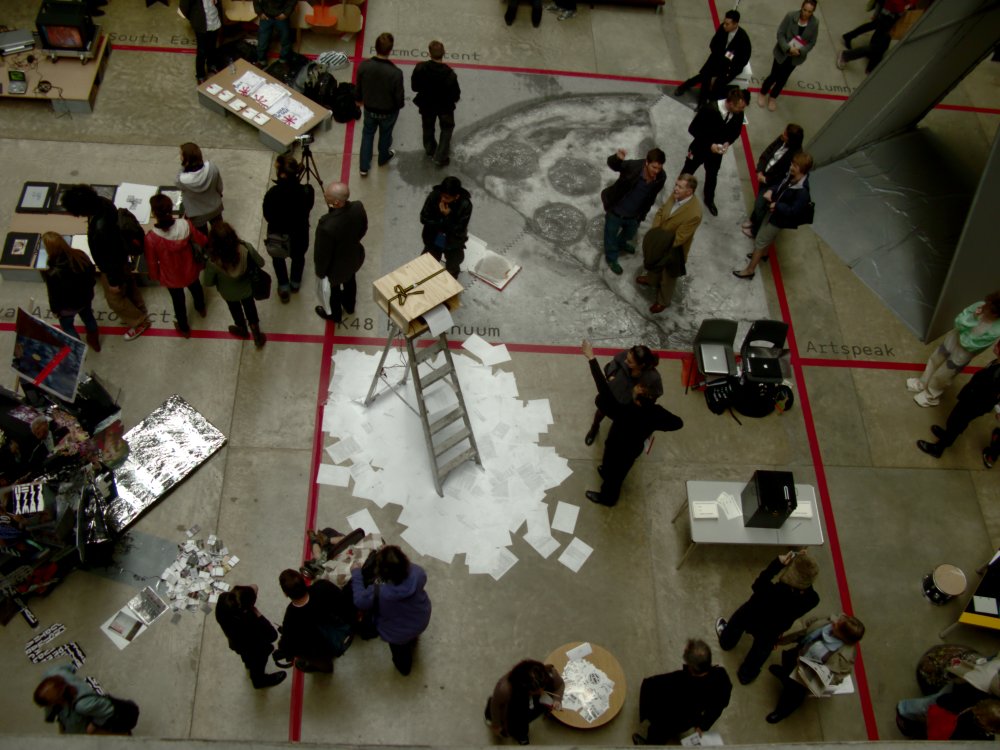
Lindner & Steinbrenner’s Start Spreading the News (2010) consists of a printer connected to the Internet continuously printing on A4 sheets of paper everything that is worth being reported by Thomson Reuters, the world’s leading press agency. This device is located on top of a ladder, so every minute 2/3 sheets of paper will tumble into the ground, each containing absolutely unfiltered news from somewhere in the world. These are words that have no feedback from the audience, allegorically replicating the way most information is circulated on a global scale. Through the poetic image of “falling news” that they created, the artists question the power of the media in the shaping of the current visions of the world.


NOTES TO THE EDITORS

NO SOUL FOR SALE is a festival of independents that brings together the most exciting not-for-profit centers, alternative institutions, artists’ collectives and underground enterprises from around the world. Neither a fair nor an exhibition, NO SOUL FOR SALE is a spontaneous celebration of the individuals and groups that live outside the market and that animate contemporary art. To celebrate Tate Modern's 10th anniversary, the second edition of NO SOUL FOR SALE, organized by Cecilia Alemani, Maurizio Cattelan and Massimiliano Gioni, and produced by Tate Modern, is bringing together 70 of the world's most innovative independent art spaces and teams to take over the Turbine Hall. The festival will fill the iconic space with an eclectic mix of cutting-edge shows and events on 14-16 May 2010.

Participants in the second edition of NO SOUL FOR SALE include: 2nd Cannons Publications (Los Angeles), 98weeks research project (Beirut), Alternative Space LOOP (Seoul), Arrow Factory (Beijing), ArtHub Asia (Shanghai/Bangkok/Beijing), Artis - Contemporary Israeli Art Fund (New York/Tel Aviv), Artists Space (New York), Artspeak (Vancouver), Auto Italia South East (London), Ballroom (Marfa), Barbur (Jerusalem), Black Dogs (Leeds), Capacete Entertainment (Rio de Janeiro), casa tres patios (Medellín), Cinématèque de Tanger (Tanger), cneai= (Paris-Chatou), Collective Parasol (Kyoto), Dispatch (New York), e-flux (Berlin), Elodie Royer and Yoann Gourmel - 220 jours (Paris), Embassy (Edinburgh), Filipa Oliveira + Miguel Amado (Lisbon), FLUXspace (Philadelphia), FormContent (London), Galerie im Regierungsviertel / Forgotten Bar Project (Berlin), Green Papaya Art Projects (Manila), Hell Gallery (Melbourne), Hermes und der Pfau (Stuttgart), i-cabin (London), Intoart (London), K48 Kontinuum (New York), Kling & Bang (Reykjavík), L'appartement 22 (Rabat), Latitudes (Barcelona), Le commissariat (Paris), Le Dictateur (Milan), Light Industry (New York), Lucie Fontaine (Milan), lugar a dudas (Cali), Mousse (Milan), Next Visit (Berlin), New Jerseyy (Basel), Not An Alternative (New York), no.w.here (London), Or Gallery (Vancouver), Oregon Painting Society (Portland), Para/Site Art Space (Hong Kong), Peep-Hole (Milan), PiST/// (Istanbul), Post-Museum (Singapore), PSL [Project Space Leeds] (Leeds), Rhizome (New York), Sala-Manca & Mamuta (Jerusalem), Sàn Art (Ho Chi Minh City), Scrawl Collective (London), studio1.1 (London), Swiss Institute / Contemporary Art (New York), The Mountain School of Arts (Los Angeles), The Museum of Everything (London), The Royal Standard (Liverpool), The Suburban (Chicago), The Western Front Society (Vancouver), Thisisnotashop (Dublin), Torpedo - supported by the Office for Contemporary Art Norway (OCA), Tranzit.cz (Prague), Viafarini DOCVA (Milan), Vox Populi (Philadelphia), Western Bridge (Seattle), White Columns (New York) and Y3K (Melbourne).


Filipa Oliveira + Miguel Amado is a Lisbon-based curatorial team that started out in 2004 with the programming of different alternative spaces in Lisbon. They have organized series of solo shows by Portuguese emerging artists that have stirred up the city’s traditional art scene. They have been working internationally since 2009, having shifted their focus from conventional exhibition formats to critically engaging, participatory projects informed by the relationships of aesthetics and ethics within artistic practice.


/////////////MAKING A LIVING \\\\\\\\\\\\\\\\

AN OPEN LETTER TO TATE

TATE: NO SOUL FOR SALE // ELEPHANT IN THE ROOM // FAIR PAY FOR ARTISTS

"We don't really cherish our artists to the degree we should."
Sir Nicholas Serota, Director of Tate, quoted in the Evening Standard 23.04.10

As a grouping of national and international artists, we publicly challenge No Soul For Sale (NSFS) at Tate Modern over the weekend of 14th-16th May 2010.

The title No Soul For Sale re-enforces deeply reductive stereotypes about the artist and art production. With its romantic connotations of the soulful artist, who makes art from inner necessity without thought of recompense, No Soul For Sale implies that as artists we should expect to work for free and that it is acceptable to forego the right to be paid for our labour.

It has come to our attention that many participants are not being paid by Tate Modern for their efforts. In fact, most are self-funding their activities throughout the weekend. Tate describes this situation as a “spirit of reciprocal generosity between Tate and the contributors”. But at what point does expected generosity become a form of institutional exploitation? Once it becomes endemic within a large publicly funded art space?

Reciprocal generosity is the lifeblood of independent art communities throughout the world. This spirit is not however the property of any one institution, artist or curator and it is complacent for Tate to believe that their position is comparable to ground level arts activity. It therefore seems disingenuous for Tate to claim that their hosting of NSFS is somehow altruistic or philanthropic. Tate publicly has the most to gain, yet we have discovered that Tate’s reciprocity does not even extend to the provision of basic resources, such as the use of chairs and tables for some of the participants in NSFS. Tate will commercially benefit from NSFS through increased audiences and the inevitable increase in the sale of books, magazines, merchandise, refreshments, donations and exhibition entry fees. Is the nature of this exchange really occurring on a level playing field? Is the relationship as reciprocal as it could be?

As many of us in Making A Living have worked with Tate and other major art galleries, we understand that the expectation of free labour and self -funding is not exclusive to NSFS. During our discussions it has come to light that Tate has not paid artists for some exhibitions, workshops and events, including last year’s Tate Triennial, and that this policy has existed over a considerable period of time, long before the current economic crisis became an issue for arts institutions.

We call for an end to this poor practice and manipulation of generosity as Tate Modern celebrates its 10th birthday. We call on Tate to make public its policy in regard to artists’ fees.

If artists continue to work for free, or are expected to pay for their efforts when working with our major art institutions, then we deny opportunities to the great majority of artists who simply cannot afford to take such financial risks. Tate and other major publicly funded galleries risk spoiling their good work by unwittingly limiting their pool of future exhibiting artists to individuals who can afford to pay for the privilege, or who are content or able to work for little or no pay. If NSFS manages to start a productive conversation about this 'elephant in the room' then we think it may yet be described as a success.

M.A.L
(Making A Living: A discussion group of Arts professionals currently active across the UK)
makingaliving@live.co.uk

/////////////PORTUGUES\\\\\\\\


O colectivo curatorial Filipa Oliveira + Miguel Amado apresenta “O Horizonte Insuperável”, um projecto desenvolvido para o evento No Soul for Sale – A Festival of Independents. Este evento reúne cerca de 70 dos mais inovadores espaços alternativos e colectivos curatoriais do mundo e realiza-se na Tate Modern, em Londres, no âmbito da comemoração do 10º aniversário desta instituição.

Lisboa, 3 de Maio – O colectivo curatorial Filipa Oliveira + Miguel Amado apresenta “O Horizonte Insuperável”, um projecto desenvolvido para o evento No Soul for Sale – A Festival of Independents. Este evento reúne cerca de 70 dos mais inovadores espaços alternativos e colectivos curatoriais do mundo e realiza-se na Tate Modern, em Londres, no âmbito da comemoração do 10º aniversário desta instituição. Após participações na primeira edição de No Soul for Sale – A Festival of Independents (Nova Iorque, 2009), na Frieze Projects da Frieze Art Fair (Londres, 2009) e na Curators’ Desk da Just Madrid (Madrid, 2010), “O Horizonte Insuperável” é o quarto projecto recentemente organizado por Filipa Oliveira + Miguel Amado em contextos de excelência internacionais.

O Horizonte Insuperável” inspira-se no pensamento do filósofo francês Jean-Luc Nancy. No livro La communauté désoeuvrée (1982), este definiu comunidade para além da sua dimensão cultural, económica e política. O projecto compreende obras de Carla Cruz, Ruth Ewan, Runo Lagomarsino e Lotte Lindner & Till Steinbrenner que exploram o potencial do ideal comunitário na contemporaneidade. À natureza ontológica de colectivos curatoriais subjaz a relação com o tecido social em que operam, assim considerando o espaço público como uma arena para a participação individual no devir colectivo. Sob esta premissa, reuniram-se artistas que abordam a comunidade como uma realidade tanto em desintegração como em construção. Assim, as suas propostas enquadram as palavras de Nancy, para quem “o testemunho mais doloroso do mundo moderno (...) é o da dissolução, deslocação ou conflagração da comunidade.”

Carla Cruz recria uma mesa de voto; porém, os boletins contém uma pergunta – “Gostaria de participar” – com respostas múltiplas e a urna encontra-se selada, impedindo o gesto democrático. De Ruth Ewans vende-se, a preço de custo, um conjunto de autocolantes com desenhos alusivos a diversos grupos radicais britânicos, incluindo a The Plebs League, inspirada pelo ideário marxista. Aludindo ao popular jogo “pinãta”, o vídeo de Runo Lagomarsino analisa as dinâmicas de opressão e resistência resultantes do colonialismo na América Latina. Lotte Lindner & Till Steinbrenner compõem um dispositivo tecnológico através do qual se imprimem continuamente, em folhas de papel A4, as notícias geradas pela agência noticiosa Thomson Reuters.

Monday, May 03, 2010

CHANTAL MOUFFE’s Democratic Paradox seen through TERRE THAEMLITZ’s Rosary Novena for gender Transitioning – Soulnessless Project.


http://www.comatonse.com/releases/soulnessless/


Assuming, as the Oxford Dictionary states, that a Paradox is a “proposition that, despite sound reasoning from acceptable premises, leads to a conclusion that seems logically unacceptable or self contradictory” and democracy is a system of government by the whole population, what is contradictory about the rule of the many? This is the starting point of Mouffe’s analyses, that the Modern Democratic project poses a threat to democracy itself.
By criticizing the supposed essence, i.e. permanent nature, of liberal democracy Mouffe builds an argument for a radical pluralist democracy.

Pluralism as the dissolution of the markers of certainty (a notion that Mouffe takes from Lefort) legitimates conflict and division and proposes equality. The modern liberal democracy accepts pluralism, but this is taken as irrelevant and relegated to the private sphere as differences being mere facts, but Mouffe argues that pluralism is a not a fact but a valuable principle that should be enhanced and not hidden. Nonetheless if pluralism is to be celebrated it is also presented with limits, Mouffe does not defend heterogeneity to an incommensurable point, she proposes a continuous challenging of the relations of subordination but not their extinction, for this relations help us building the “we” which is the construction she claims as holding the political dimension.

Then in order to understand the importance of conflict she shows the eradicable nature of power. Objectivity, i.e. identity, is perceived always in opposition to something outside itself, and that outside is what makes it perceptible, so is part of its nature, power is identity’s “constitutive outside”. Identity is consequently contingent and therefore no one can claim to represent the totality. Power relations will always be there, so democracy can not be about abolishing power and antagonism, therefore the question is how to transform antagonism and Power according to democratic values?

Liberal democracy by concealing pluralism instead of building institutions that could present antagonism (rivalry) in an agonistic (contestant) way creates a problem, this being the transformation of political adversaries into enemies; and by presenting its institutions solid as real buildings unlegitimates and irrationalizes any possible challenge. Since homogeneity is an illusion and consensus an impossibility, what Mouffe proposes is a continuous and permanent agonistic conflict that instead of trying to erase power, brings it to the fore so it can be challenged.

Terre Thaemlitz is not looking for consensus, he is not looking for political correctness. He affirms boldly in his performance: I hate all religions.
For he is not an atheist that tolerates others belief, he re-asserts:

- I hate all religions. Without exception. Yours too.

Here, in the first part of his project Soulessness: ROSARY NOVENA FOR GENDER TRANSITIONING, Thaemlitz is deconstructing is own religious upbringing, his catholic upbringing.
So when I speak against religion and spirituality, I do so not as a person with the rare luxury of a secular upbringing, but as a person who has struggled to overcome one's own spiritual programming, and who sees others struggling to do the same. I assure you, any harshness to my words rests in defensive panic, not arbitrary aggression. I do not stand proudly before you. I am laying prostrate, an anti-Holy Roller speaking in tongues, trying to catch my breath for one more kick and "Fuck you!" against the endless trample of faiths and superstitions framing my existence in this world from birth to death. I concede the inescapability of religious and spiritual dogma to one degree or another in all corners of life - from extremist religious militarism to the seemingly harmless transcendental pretenses of "soul music," ambient, new age, classical, pop, rock, folk, house... No matter how much I wish for the eradication of spiritual thinking, I have no faith in the possibility of an atheist society or godless world. I am truly without faith. In a media marketplace that demands soulness, I can only offer soulnessless.

Thaemlitz presents this project as lecture performances, directing the narrative in the first person, where theory and facts are interwoven, to a point where it does not really matter the veracity of the facts, they serve to grip the public to his narrative. He stands before the audience in drag, dressed as an old fashion schoolteacher, reading from his notes (which are transcribed in his website). Subsequently he projects a video, where the audio is of equal importance, we should not forget that he is mainly an audio artists. The performance started with this anecdote:

I lived in Oakland, California. Although I did not own a radio receiver, the wires in my studio acted as an antenna, filling the line noise with religious broadcasts from a local public-access radio station.
Some might call them messages from God.
I called them fucking annoying.

The grainy video tells the story of an encounter, or an heritage. A little figurine owned by his grandmother led him to a whole new reading of catholic dogmas, the sinless conception of christ, his death and ressurection. Through the wax figurine of the Virgin Mary displaying a large erected penis to the stained glass representation of the Piéta; Thaemlitz takes us on a journey of individual transubstantiation, not of blood into wine, but of female into male and back again.
The woman that engenders from her own body her sexual opposite, and dies to return to the female form. ROSARY NOVENA is transgender tale.

I use the concept of agonistic pluralism to present a new way to think about democracy which is different from the traditional liberal conception of democracy as a negotiation among interests and is also different from the model which is currently being developed by people like Jurgen Habermas and John Rawls. While they have many differences, Rawls and Habermas have in common the idea that the aim of the democratic society is the creation of a consensus, and that consensus is possible if people are only able to leave aside their particular interests and think as rational beings. However, while we desire an end to conflict, if we want people to be free we must always allow for the possibility that conflict may appear and to provide an arena where differences can be confronted. The democratic process should supply that arena. (MOUFFE, 2000)
I believe Thaemlitz is performing that arena. Presenting us with the affects of such liberal pluralist project that diverts conflict into an underground space, erupting violently on specific subjects, on him.

A limited inquiry into the influences of Catholicism in my own life would be a safer topic to discuss here, since anything less subjective could be labeled culturally insensitive, bad karma, anti-Semitic, demanding fatwah, or any number of other curses bestowed upon outsiders. I wish to limit the potential for such curses because I have already endured acts of verbal and physical violence at the hands of Christians, and suspect that fanatical followers of the other great religions of the world are no less capable of the same.

Thaemlitz voices dissent, he does not play the general tolerant model, that “forces the participants to leave aside all their particularities and interests.” (Mouffe, 2000, 87), the democratic tension is ineradicable and Thaemlitz performs it. Critic of spiritualism and the patriarchy society, he uses the symbol of the Virgin Mary, but has he states, not only as a possible feminist icon, but beyond that, as a gender trouble. Extremely critic, as well, of sexual transition through surgery, because in the end what happens is that we all conform to the old same binary of male female. The same old roles, the same old play. Thaemlitz ends the video with a hymn, sung to medical footage of vaginoplasty operation.

On that resurrection morning
When all dead in Christ shall rise
I'll have a new body (Praise the Lord)
I'll have a new life
Won't it be so bright and fair
When we meet our loved ones there
I'll have a new body (Praise the Lord)
I'll have a new life

I'll have a new home of love eternal
Where the redeemed of God will stand
There'll be no more sorrow (No more pain)
There'll be no more strife
Raised in the likeness of my savior
Ready to live in paradise
I'll have a new body (Praise the Lord)
I'll have a new life

When ol' Gabriel blows his trumpet
And we walk the streets of gold
I'll have a new body (Praise the Lord)
I'll have a new life
No more pain, worry, sorrow
In this wicked world of sin
I'll have a new body (Praise the Lord)
I'll have a new life

I'll have a new home of love eternal
Where the redeemed of God will stand
There'll be no more sorrow (No more pain)
There'll be no more strife
Raised in the likeness of my savior
Ready to live in paradise
I'll have a new body (Praise the Lord)
I'll have a new life

Oh dear brother are you livin'
For that day when Christ shall come
I'll have a new body (Praise the Lord)
I'll have a new life
Graves all burstin'
Saints a' shoutin'
Heavenly beauty all around
I'll have a new body (Praise the Lord)
I'll have a new life

This sex change, for her, levels down the necessary complexity of gender identities, and the tale of desire to embody the idealized shape is counter posed with the compulsory sex change that homosexuals have to go through in Iran when stating their homosexual preference openly.


Thaemlitz finishes her video presentation and opens the performance to questions from the audience. Again we can sense the opening up of that space for articulation of antagonism, but is society prepared to voice differences and still be able to break some bread afterwards? For Mouffe the goal is to transform antagonisms into agonism. “This requires providing channels through which collective passions will be given ways to express themselves over issues which, while allowing enough possibility for identification, will not construct the opponent as an enemy but an adversary.” (MOUFFE, 2000, p.103)

How can we construct society on this model, against the liberal notion of being a mere collection of individuals and interests groups? For Mouffe “the prime task is not to eliminate passions from the sphere of the public, in order to render rational consensus possible, but to mobilize those passions towards democratic designs.” (MOUFFE, 2000, p.104) We can hint the open up of that place of encounter, of dissent in Thamelitz work, but how will the democratic institutions that could embody society agonistic play, in large scale, look like? Thaemlitz is very pessimistic; she does not believe that there will be any substantial change, even though we can witness this change in her performance; so while not believing in change she is already performing that very same change. And even though we cannot envision the agonistic institutions that Mouffe argues for, where ‘conflictual consensus’ can be achieved, Thaemlitz is voicing out loud all that remains hidden, all that can be only uttered as private (here I mean as non public therefore almost as non political). Hers, as many other projects, is maintaining this possible agonistic pluralism, and therefore keeping “the democratic contestation alive” (MOUFFE, 2000, p.105). Thaemlitz performs democracy, but could it really be institutionalized, as Mouffe believes, in order to save democracy as a form of government and society, or is democracy something else, or better, lying somewhere else, ‘below and beyond’ state policy.

Mouffe argues that the common good is always something unreachable, is “a vanishing point, something to which we constantly refer when we are acting as citizens, but that can never be reached.” (MOUFFE, 1992, p.379) While for Rancière democracy is not a form of government nor a type of society, but egalitarian relations “that are traced here and now through singular and precarious acts,” is there is where we can spot democracy. (RANCIÈRE, 2006, p.96) Somehow their positions do not seem very different, but while Mouffe believes that change, even if precarious, can be achieved through governance, Rancière alert us to look at all that we consider today as democratic achievements, and how they were actually achieved outside the state framework, through people’s struggles and isolated acts.

My queries are these; what could an agonist democratic institution look like, and is it really necessary, or could democracy maintain itself on these temporary agonistic platforms, such as those provided by the arts? Moreover if democracy will never be a form of government but precarious single acts between equals, what is the role of organized social struggle and how can we envision different forms of community? What it seesm to happen in Thaemlitz work, for example is the possibility of different forms of community and empowerment within our oligarchic societies, done with the belief that nothing susbtancial will change, but it must be done anyhow. Although, I might accept that potential for change can be found in that articulation, I am still puzzled with the possibility of a truly democratic governance. But maybe I am down in the belief trap that Thaemelitz so violently urges us not to fall into.


NOVENA PRAYER (FOR NINE DAYS)
Hail, O Lady of Gender Transitioning, Holy Queen, Mother of Mercy, my hope!
To Thee do I send up my sighs, mourning and weeping in this valley of tears.
O Holy Mother, in this age when feminine napkins are sold by South Korean transgendered celebrity Harisu, as Your imitators we beseech Thee for humility.
Forgive her envy of menstruation as that which she is "jealous of and wishes to do as a woman," and forgive my envy of sexual reassignment surgery as that which I am jealous of and wish to do as a "man."
Bless me, as You have blessed her, in granting faithful imitation and homage to Thine sacred womb, to give birth to my gender opposite.
Bless me with Thine beauty and grace.
Bless me with the heavenly riches necessary to complete such a transformation.
May the financial success of this audio project serve as the sacred seed of my own menstruation, an idillic flow like that seen in tampon commercials, a holy blue flow reflecting the plasticity of gender transitioning, draping my legs like Your blessed blue robe, that I may follow in Thine image.
O Lady of Gender Transitioning, pray for this sinner now and at the hour of my death, and receive me in my resurrection. This I humbly pray in Your name. Amen.


CHANTAL MOUFFE is a Belgium political theorist, knowned exactly for this notion of the pluralist agonistic democracy. From her vast work she is better known for have writen Hegemony and Socialist Strategy: Towards a Radical Democratic Politics with the Argentinian political theorist Ernesto Laclau in 1985.

TERRE THAEMLITZ is “a multi-media producer, writer, educator, DJ and owner of the Comatonse Recordings record label. His work combines a critical look at identity politics - including gender, sexuality, class, linguistics, ethnicity and race - with an ongoing analysis of the socio-economics of commercial media production. This diversity of themes is matched by Thaemlitz' wide range of production styles, which include electroacoustic computer music, club oriented deep house, digital jazz, ambient, and computer composed neo-expressionist piano solos.”

http://www.comatonse.com/thaemlitz/gigs.html

Thaemlitz is both addressed as male and female throughout this paper both because his own appearance in drag in the performances and her self address in her website are always in between male / female binary, therefore I used the hymn of gender transition to do the linguistic change on Thaemlitz, in lack of a better tool to convey her own gender troubling in a society where one can still not be gender neutral.


MOUFFE, C (1992) Feminism, Citizenship, and Radical Democratic Politics. In BUTLER, J. and SCOTT, J. W. 1992. Feminist Theorize the Political. Routledge.
MOUFFE, C. (2000) The Democratic Paradox. London, New York. Verso.
RANCIÈRE, J. 2006. Hatred of Democracy. Verso.
THAEMLITZ, T. (2009) http://www.comatonse.com/writings/becoming-minor.html (01.05.2010)

Sunday, April 25, 2010

ON SPINOZA’S POLITICAL TREATISE


Emanuel de Witte 1675

The world cannot have been created for any purpose other than which it fulfils by being that it is. To say that it has been created for the good of man, or for any similar end, is to indulge in grotesque anthropomorphism. (XXV)

Spinoza (1632–1677) was a contemporary of Thomas Hobbes (1588-1679) and pretty much influenced by the latter. Hobbes thought of humanity as self-interested and always struggling for power and, in his 1615 Leviathan, set out to understand why and how can men actually cooperate and trust each other despite their nature. Hobbes idea, as pointed out by David Held in Models of Democracy, is that to be able to escape a lonely, hard and most certainly short life men have to come together. So society is better than natural state, and as Spinoza would argue, in choosing between two goods or two evils one goes for the greatest of the goods and lesser of the evils, and this could almost be an universal truth, and the reason why men are willing to “surrender their rights of self-government to a powerful single authority” (Held 1996), for the sake of security and self preservation. Hobbes theories were the beginning of the need to establish “both the liberty of individuals and sufficient power for the state to guarantee social and political order.” (Ibid) Hence he thought that the perfect state was absolute but with the consent of the people. “A multitude of men, are One Person, when they are by one man, or one Person, Represented” (ibid – Leviathan p. 220). A sovereign, therefore, is someone or a group of people who has been given the right of governing through the social contract.

But before engaging in his own definition of the perfect government Spinoza will spend a considerable time convincing his readers, in his Theological-political Treatise, that the Bible “leaves reason absolutely free; that it has nothing in common with philosophy, in fact, that Revelation and Philosophy stand on totally different footing” (p. 9); demonstrating that there is no contradiction between being religious, i.e. obedient, and scientific experimenting and thinking. If we are looking for empiric knowledge we won’t find it in the bible. He always sought to “separate philosophy from theology, and to show the freedom of thought which such separation insures both” (p. 200) and having done that he could concentrate on the pursuit of the ideal state.

The concern of philosophers have been to understand what is the aim of the state, and how can a state secure that aim, but even before focusing on what is the goal and goodness of a state, the question might be how can men live together?

According to Spinoza “every individual has sovereign right to do all that he can; (p. 200) so the individual who does not “yet know reason” will act “solely according to the laws of his desire” as the wise man will live according to the laws of reason … “the natural right of the individual man is thus determined, not by sound reason, but by desire and power.” (p. 201) But men, he continues, that do not live in community and by reason “live most miserably”, as argued also by Hobbes, therefore “men must necessarily come to an argument to live together as securely and well as possible if they are to enjoy as a whole the rights which naturally belong to them as individuals, and their life should be no more conditioned by the force and desire of individuals, but by the power and will of the whole body” (p. 202) deciding by doing so to be guided by reason. The question is, how to keep men under human law? If everyone was led by reason, they will keep the social pact for the sake of the good of the state, but according to both Hobbes and Spinoza this is not true. Spinoza believed that mankind is drawn away by pleasure so we are only restrained by the hope of some greater good, or the fear of a greater evil.

Balibar, in Spinoza and Politics, explains how Hobbes argues that in order to establish security, “natural right must be replaced by civil right” (Balibar 1998) which can only be imposed by a higher force, the state, and through the acceptance of the social contract, the natural state is replaced by the “body politic”. But Spinoza rejects this distinction between “natural right” and “civil right”, for him freedom of thought lies beyond the reach of the state.

Having come together in society men are giving away part of their rights and power, but this, argues Spinoza, would not enslave them, because the individual might be less free but the state is the freest; the subject “obeys the orders of the sovereign power, given for the common interest, wherein he is included.” (p. 215) Here we can see how he differs from Hobbes, for men remain as they were in the state of nature, equals, because no one transfers his rights absolutely, one still has a voice. Furthermore even in acting out of fear for the state, men act according to their own thought, “obedience does not consist so much in the outward act as in the mental state of a person obeying.” (Ibid)


Security or common good have been seen as the aim of governance but for Spinoza the true aim is liberty. The best government allows “freedom of philosophical speculation no less that of religious belief” (p. 263) and this is why we went to such a length defending freedom of thought in the Theological Political Treatise. Freedom of speech was of extreme importance to Spinoza, which saw no contradiction between the liberty of saying what one thinks and the authority of the sovereign power.

Spinoza, as Hobbes, desired an absolute state, but, unlike the latter, he believed that it could be in the hands of the multitude, i.e. it could be a democracy. In a democracy “everyone submits to the control of authority over his actions, but not over his judgment and reason (ibid)

As Balibar exposes, all of Spinoza’s arguments, in the Political Treatise, are to prove that the closer a state is to democracy the stronger it will be. “The basis and aim of a democracy is to avoid the desires as irrational, and to bring men as far as possible under control of reason, so that they may live in peace and harmony: if this basis be removed the whole fabric falls to ruin.” (Balibar 1998) Moreover that his democratic propositions are strongly connected to his belief in equality and freedom, freedom of thought as mentioned above and equality between all citizens, which can “exist by the joint result of institutions combined with collective praxis” (ibid)


But Spinoza’s argument, weaved in the Political Treatise thought the analyses of different political regimes, was left unfinished in the middle of the democratic regime, for he died before being able to conclude it, but as Balibar points out, in all regimes’ analyses we see the tendency to democracy “the less sovereignty is physically identified with one fraction of society… the more it will tend to coincide with the people as a whole, and the stronger and more stable it will be. But at the same time, the more difficult it will be to imagine its unity (its unanimity) and its indivisibility (its capacity for decision), and the more complicated it will be to organise them in practice. (Balibar 1998) The question left unanswered then, and still threatening contemporary democracy is, how can the multitude govern its own passions?

“[E]very individual wishes the rest to live after his own mind, and to approve what he approves ... reason can ... do much to restrain and moderate the passions, but ... the road, which reason herself points out, is very steep...” (p. 289) Reason will then refrain the passions, but it does not mean that it destroys them; and passions, Balibar argues, create forms of dependency to others.


To better understand Spinoza’s preference for the democratic rule we follow his own path: what is the best Dominion?

“Where men have general rights, and all guided, as it were, by one mind, it is certain that every individual has the less right the more the rest collectively exceed him in power; that is, he has, in fact, no right over nature but that which the common law allows him. But whatever he is ordered by the general consent he his bound to execute, or may rightfully be compelled thereto. This right, which is determined by the power of a multitude, is generally called Dominion.” (p. 297)

He continues by saying that if the rule, which is decided by the multitude, is entrusted to a “council composed of certain chosen persons” we are facing an aristocracy; if to a sole man, then it will be a monarchy, if “to a council, composed of the general multitude” (ibid) then the dominion is a democracy. But what is the best, i.e., which one can ensure individual’s liberty? Spinoza thought that the best and most independent would be the one “founded and guided by reason” (p. 313) and he added... “a free multitude is guided more by hope than fear” (p. 314). Hope is then the bond between individuals and of those with the state. Hope in Liberty?

How can a Monarchy ensure a good governance and freedom? According to Spinoza, a monarchy is always, in fact, an aristocracy; for no man can “by himself hold the supreme right of a commonwealth.” (p. 317) Moreover, because normally aristocrats are more interested in securing their lineage and plotting against each other, than governing for the people, their subjects will be under worst conditions. Nevertheless, and because from his perspective politics is the science of preserving the state, Spinoza will articulate how could a monarchy persist. First a monarch should be careful of is own inconstancies. “Every law be an explicit will of the king, but not every will of the king a law.” (p. 328) And he thought that the multitude would be willing to hand to a king that “which it cannot itself have absolutely within its authority, namely, ending controversies” (p. 330) and regarding that the king is surrounded by many counsellors that can express the multitude’s interests, “the multitude may preserve under a king’s an ample enough liberty, if it contrive that the king’s power be determined by the sole power, and pursued by the defence of the multitude itself.” (p. 344)


What about aristocracy?
“A king needs counsellors, but a council like this” as we said before, composed of chosen people, “doesn’t. Kings are mortal, but councils are everlasting” (p. 346) Here the multitude is under no consultation and the only reason why aristocracy is not absolute is because the council fears the multitude, therefore the multitude retain some liberty, even if only by a tacit agreement. Spinoza’s conviction was that “aristocracies were formerly democracies… that augmented with foreigners…” (p. 351) and since those could not become citizens of full rights a class of patricians was formed. Spinoza states that if “the nature of patricians was that they were free from all passions (in choosing who his or not a citizen) and guided by mere zeal for the public welfare in choosing their patrician colleagues, no dominion could be compared with aristocracy.”(p. 387) but has said before, reason can refrain passions but never extinguish them.


Therefore we arrive at the third dominion; democracy, which differs from aristocracy mainly because the latter “depends on the supreme council’s will and franchise only, that this or that man is made a patrician, so that no one has the right to vote or fill public offices by inheritance, and that no one can by right demand this right as is the case in the dominion whereof we are now treating.”(Ibid) Thus, a man can claim the right to vote and fill public offices, and even if the supreme council might have fewer citizens this shall still be called a democracy, “because in them the citizens who are destined to manage affairs of the state, are not chosen as the best by the supreme council, but are destined by law.”(Ibid)

That the rule is chosen by lot is the main characteristic of democracy, how it can be, as Spinoza wished, an absolute government is what he did not succeed to explain. Therefore the only clue given has to why he thought this would be the best dominion is what Balibar points out when we says that in the analyses of the former dominions, they are best as they approach a more democratic governance.

But then, how can the multitude govern its passions when one knows that every man thinks the other should live as he does? Can state institutions distil the multiple opinions into a common opinion? Although true equality does not exist and can only be achieve through the action of the state, as true independence does not exist, and citizens have to establish relations of dependence between each other and between them and the state; it is this state and their institutions who should “distil a single opinion, and thus a choice, out of the fluctuation of minds” and to produce a union around a common purpose. Then, as Balibar states, it is imaginable that the multitude might rule itself “on the basis of the dialectic between these two forms of rationalisation of the State, one of which begins by privileging equality, and the other, freedom”. (BALIBAR 1998)


BALIBAR, E. 1998. Spinoza and Politics, Verso.

HELD, D. 1996. Models of Democracy. 2nd edition, Cambridge: Polity Press.

SPINOZA, B. 1951. A Theological-Political Treatise. Dover Publications.

Sunday, April 18, 2010

ANGEL SQUARE #3 // PRAÇA DO ANJO #3


354kg, 118€

“The Porto’s Court of São João Novo ordered yesterday, X, to a prison sentence of four months on charges of receiving stolen goods, the only unlawful act proved in trial”; wrote, in november 2009, M. Claudia Monteiro in the Newspaper Notícias. As an urban tale remains the story that the alleged thieves withdrew energy – to power the equipment needed to shred the bronze sculpture – directly from one of the Clérigos Shopping abandoned stores. The female angel, created by the sculpture José Rodrigues, valued at 200 thousand euros, is the thread to the history of this square. Initially called Angel Square, as the legend tells that the wife of D. Afonso have fallen there from her donkey, and the king ordered that a chapel should be erected on the place. It was after an outdoor market and later, when Porto wanted to appear as a truly European city, that it became Lisbon Square and Clérigos Shopping.
In 2006, none of the refined stores remained open, the space being used only as access to the underground parking. And more specifically, in December 22nd, thieves, who were neither members of an international art trafficking network, nor bearing Zorro’s masks, decided to strike the final blow to a space death at birth.
How many more similar spaces will arise in the city to fall, not under the thick cover of a great cataclysm such as Pompeii, but due to the rapid erosion of the negligent planning of our leaders?
Association of Friends of the Angel Square, Porto 2010.


354kg, 118€

“O Tribunal de São João Novo, no Porto, condenou, ontem, __ a uma pena de prisão efectiva de quatro meses, pelo crime de receptação negligente, o único acto ilícito provado durante o julgamento.” Escrevia M. Cláudia Monteiro em Novembro de 2009 no Jornal de Notícias. Como mito urbano ficará a estória de que os presumíveis assaltantes retiraram a energia – necessária ao equipamento para retalhar a escultura em bronze – directamente duma das lojas abandonadas do Clérigos Shopping. A anja, de autoria do mestre José Rodrigues, avaliada em 200 mil euros, é o fio condutor à história desta praça. Inicialmente denominada Praça do Anjo, pois conta a lenda que a mulher de D. Afonso aí terá caído do burrico, terá então o rei mandado erguer uma capela. Foi depois mercado ao ar livre, e mais tarde quando o Porto se quis dar ares de cidade europeia, transformou-se em Praça de Lisboa e Clérigos Shopping.
Em 2006, nenhuma das lojas de mercadorias finas restava aberta, sendo o espaço apenas usado como acesso ao parque de estacionamento subterrâneo. E mais precisamente a 22 de Dezembro, uns ladrões, que não seriam membros de uma rede de tráfico internacional de arte, nem possuidores de mascarilha, resolveram dar o golpe final a um espaço moribundo à nascença.
Quantos mais espaços semelhantes se erguerão na cidade, para caírem, não sob o manto espesso de um fantástico cataclismo como o de Pompeia, mas, devido à rápida erosão de um planeamento negligente dos nossos líderes?
Associação de Amigos da Praça do Anjo, Porto 2010.


Carla Cruz and Ângelo Ferreira de Sousa at Sousa Ribeiro shop for the Troca-se por Arte event, Porto.

Sunday, April 11, 2010

Monday, March 22, 2010

at Brno - czech republic


Trying out some arguments on public space, participation and collaboration of the audiences at Brno University of Technology, Faculty of Fine Arts.

The worst question I can ever be asked is: “You’re an artist! What type of art do you do?”, I can’t answer straight and I always seem to stutter.

...

And if public sphere, or public space was always connected to politics, or, lets say, it was a way of measuring the pulse of our democratic society, to attest its health, it seems to be less and less part of the political and philosophical discourse, as if of a cadavre we are talking about, and there is nothing much we can do about its situation, than just to forget.

“Participatory practices presumes that there is a difference between the producer and receiver, but the focus is on the latter, to whom a significant part of the development of the work is transferred”(Maria Lind, 2007)

Friday, February 19, 2010

Notes#022

"POWER2010 has entered the final few days of its public vote - where anyone can go online and vote for the changes they'd make to British democracy. Of the 29 ideas in the vote, themselves submitted by members of the public and then endorsed by a Deliberative Poll of a random selection of the population, only the top five come midnight on Monday will make the cut as a set of people's proposals for democratic renewal." quoted from opendemocracy.net
POWER2010 enter site to vote

Notes#021


"Michael Landy transforms the South London Gallery into 'Art Bin', a container for the disposal of works of art. As people discard their art works the enormous 600m³ bin becomes, in Michael Landy’s words, “a monument to creative failure”.
where to apply to discard your work

Notes#020

...thinking of CRISTIANA ROCHA's work when reading Agamben's comming community, specially the idea of the inessential character of the whatever singularity ... not that I fully understand why.

In 2007 at the massive participatory even "Serralves em Festa", at Porto's contemporary art museum, Rocha invited the audience, according to some specific characteristic, to come together at a particular hour of the day at a particular time, and only them the commonality appeared...

see more here

Thursday, February 18, 2010

Louder than BOMBS

BOLHÃO

Thursday, February 11, 2010

Notes#019


@http://www.edinburghsculpture.org/magazine.html

Democracy according to Aristotle and the Revolutionary Workers in Venezuela.

A society is called a State when it has a collective aim, and according to Aristotle it aims at the highest good, this good is of the State itself and not of each citizen’s as individual.

Naturally, thought Aristotle, this State shall have rulers and subjects and is to be governed in a way ‘where everyman can act best and live happily’. This happiness is bond to wisdom and not to material possessions, but to be wise one has to have leisure time and not be engaged in everyday life survival, therefore wise man must be provided with property. Here comes a vicious circle, those who are wise must be entrusted with property, those with property and free time will certainly be wiser. So property is again a condition to rule and in the end of the day Aristotle polity is an oligarchy.

Nowhere in his treatise Aristotle considers a State without rich and poor; even though he affirms that the best States are those where the middle class is the larger class; as a matter of fact it could be accepted – there have been always rich and poor, but is troubling when it is never questioned why are always the same getting the best gifts from Fortune, for it seems that there is not much class interchange in his treatise.

Education is paramount to Aristotle’s constitution, and it is a matter of the State; this reveals which instrument is used to maintain each player in its own position, for education is the same among equals but some are equals as possible rulers and others equal as permanent subjects. Aristotle will use a similar argument to Plato’s to differentiate natural rulers and natural subjects making an analogy with the anatomy of the soul where one part – rational – naturally rules and the other – irrational – is ruled. Again why some are soul and others body is difficult to accept as natural.

Now, let the citizens rule! But what is a citizen? A citizen is not an individual who lives in a certain State, he is the one who takes part of the government of the State; and the constitution will be different if this government is in the hand of one, or of few, or of many; and of course governing to the common interest otherwise they are perversions. The best constitutions are then, according to Aristotle, kingship, aristocracy and polity or simply constitution, which is a ‘fusion between oligarchy and democracy, inclining towards democracy in an attempt to unite the freedom of the poor and the wealth of the rich.’

In practice there are only two types of government: oligarchies and democracies, both perversions, or imperfect constitutions. A form of government is a democracy when the free, who are also poor and the majority govern, and an oligarchy when the rich, being few, rule. Focusing only on Aristotle notion of democracy, we find that it arises out of a revolution based on ‘the notion that those who are equal in any respect are equal in all respects; because men are equally free, they claim to be absolutely equal.’ With which he disagrees, because men are rarely absolutely equal, the simple fact of being young or old, he would argue, differentiate men. And because a democracy governs towards the interests of the majority and not of the common is, therefore, a perversion.

Nonetheless the main characteristics of democracy, for Aristotle, are: ‘the election of officers by all out of all; and that all should rule over each, and each in his turn over all’; the appointment to every office is made by lot; the possession of property should not be required for offices; no one should hold an office twice, and this tenure should be brief; all men should judge, in all matters, or in the most important; the assembly should be supreme over all causes, or the most important. This highest type of democracy is based strictly on equality, rich and poor have the same right to hold office and the multitude has supreme power. But because it is the highest it is also the worst type.


As a counterbalance I propose a look at 5 Factories, the 2006 documentary by Dario Azzellini and Oliver Ressler about five self-managed factories in Venezuela, which seems to show that a democratic rule is possible. After the Bolivarian Revolution (term coined by the Venezuelan president Hugo Chavez to refer to the social movement, or twenty first century socialism in South-America) many workers in Venezuela took charge of factories that they had worked on and had been closed down by their former administrators as ruined and led them to full operational plants. Organized in cooperatives, the five examples given in this documentary portray a different way of managing a company, a social administration way. Taking the example of the presented CAIGUA tomato sauce factory, which won a government subsidy - already during Chavez legislation – to invest in modern equipment and enlarge the range of products, but which subsidy was diverted for personal expenses, I will demonstrate how a democratic management is done. The workers, realizing, that the factory was working only at 10% of its maximum capability, due to lack of raw material but specially due to ill administration, saw in the misuse of the government’s subsidy and the lack of payment the excuse they were looking for to take the management of the plant in their hands. Occupying the factory day and night over three months, they prevented the former administration to enter the facilities. Encouraged by Chavez government they constituted a cooperative, that gives shape to their social struggles. Part of this different way of managing a company, which is directed towards the benefits of the whole community and not only of the company itself, CAIGUA helped the local producers with machinery in order to augment the producing of their raw material, tomatoes. The company is managed by a temporary board of directors, selected from the body of workers, which works closely with the assembly all, 58, workers. All the projects and decisions pass by this assembly where all the opinions count. It seems only possible because there is such a small body of workers, critics of democracy would argue; but in another example presented in this documentary, an aluminium plant, the same management is being done with 3200 workers. Part of the success of these co-managed companies is due to the fact that all workers are informed of all the procedures necessary for the company’s production and management; that all workers are involved in all decisions and also because part of this type of cooperative administration involves a social-political engagement and education. At CAIGUA all workers earn the same salary, being administrators, technicians, or operators; and the surplus is distributed between the community by supporting education centres, medical care or opening their canteen tho the most needed. The aim of a democratic state, Aristotle would say, is liberty. Listening to these workers one can understand this idea of liberty, of not being constrained to express one’s opinion and ideas regarding the management of the common, but they are also aware that it does not mean simply licence - as described by many democratic critics.


The danger for Aristotle is that in democracy ‘the people becomes a monarch’, which grows into despotism. The best democracy, for him, would then be that which is subject to the law. The multitude is not call to decide upon every matter, specially the most important, for those would be in the hands of the magistrates; and the best citizens are in charge, so the more qualified represent the uninformed.

Yet, we realize in this documentary that when a worker feels that his opinion counts; that the company also belongs to him and that the result of his labour will benefit not the company and its few owners but himself and his community; he will be engaged in aiming at that Aristotelian highestgood, which is not the good only of himself but of the community, and ultimately he is HAPPY.

Aristotle, 1921, The Works of Aristotle, Oxford, Clarendon Press
Azzellini, D. and Ressler, O. 2006. 5 Factories. [DVD].


@http://www.artandresearch.org.uk/v1n2/ressler.html

(An Ideal Society Creates Itself: Venezuela and the Bolivarian Process) Oliver Ressler

see also the text "Can the Bolivarian Process Achieve Socialism? 5 Worker-controlled Factories in Venezuela" by Sharat G. Lin

Saturday, February 06, 2010

Notes#018


Different types of constitutions


Wednesday, January 27, 2010

Notes#017


Abraham Bosse (attr.)
Frontespiece to Thomas Hobbes'
Leviathan, or the Matter, Forme, And Power
of a Common-Wealth Ecclesiasticall and Civil.
1651

Thursday, January 21, 2010

Notes#016

Twitted by GRAVANA:
"Camera aboard a NASA spacecraft orbiting Mars will soon be taking photo suggestions from the public http://ow.ly/YU4x"

It reminds me of an overheard comment on how fashionable participation is nowadays, from televote to educational services in museums ... to NASA. With no sarcasm I say, when not mandatory there is something really powerfull about participation ...


"Since arriving at Mars in 2006, the High Resolution Imaging Science Experiment, or HiRISE, camera on NASA's Mars Reconnaissance Orbiter has recorded nearly 13,000 observations of the Red Planet's terrain. Each image covers dozens of square miles and reveals details as small as a desk. Now, anyone can nominate sites for pictures.
...
The idea to take suggestions from the public follows through on the original concept of the HiRISE instrument, when its planners nicknamed it "the people's camera." The team anticipates that more people will become interested in exploring the Red Planet, while their suggestions for imaging targets will increase the camera's already bountiful science return. Despite the thousands of pictures already taken, less than 1 percent of the Martian surface has been imaged." see the rest of the article here http://ow.ly/YU4x

Participants will not be just anyone, for the suggestions are sellected 'based on science rationale', it is, therefore, targeted to science students and professionals. I have created my account but since I could not provide any further rationale then curiosity I won't be able to suggest any target for NASA's camera nor receive my own picture of Mars terrain, oh well, "public" is only universal in theory anyway!

Notes#015

Is it the question of maintaining a public sphere the question of the possibility of democracy?

ORWELL: Political purpose - using the word "political" in the widest possible sense - the desire to push the world in a direction, to change other people's ideas about the type of society for which they should fight. (2008, 17)

I have always defended artistic intervention in public space, for the defense of a participated public sphere, therefore democratic and this is my political purpose. But what is public sphere or even democracy and its relationship with art it is still to be understand, and what I share here is just the beginning of a search. Neither the fabric is woven, or the loom ridden, but only the warp preparation is being done.

The bourgeois public sphere, which Habermans gives account of its disintegration in the The Structural Transformation of the Public Sphere, was a the late eighteenth century sphere of private individuals gathered as a public and thus controlling public authority. This enlightened public use of reason was not only the courage to think for ourselves, but to do it aloud, and is seen as the paradise lost, but with the mixture of state and society in the late nineteenth and early twentieth century a 'public sphere has lost its political function, namely: that of subjecting the affairs that it had made public to the control of a critical public.’

Salons disappeared, in the course of twentieth century, the leisure activities of culture-consuming public replace them, but these new activities do not require any critical discussion. The diagnosis was that the discussion has become a mere exchange of tastes and preferences among consumers since the occupation of the public sphere by the dispossessed masses, which led to an interlocking of state and society that has demolished the old foundation of that sphere without supplying a new one.

The importance of a critical public sphere in connecting society with the state seems still paramount to democratic theory, therefore many defend its rehabilitation, but is there only one public sphere, or are they multiple?

HANNULA: The idea of an open public sphere, where so the story goes, all interested parties can collaborate and exchange ideas equally is a beautiful dream, but not much more that that. Public space is a tool of control, and a tool for achieving certain ends. (2006, 74)

Let’s admit the plurality of public spheres – but Habermas considers only a democratic public sphere, which does not coincide with the public spheres of mass culture, is one and only one in which citizens could communicate about the regulation of public affairs.’

Unlike Habermas the Viennese philosopher Marchart opposes to this idea that the democratic public sphere 'is naturally privileged over others’. He asks, ‘what makes all the various "partial" public spheres such as the everyday public spheres of advertising, backstairs gossip, sports events, youth cultures, etc. any less public, less autonomous or less universal than a public sphere created through rational discussion.’

LACLAU: For me, a radically democratic society is one in which a plurality of public spaces constituted around specific issues and demands, and strictly autonomous of each other, instils in its members a civic sense which is a central ingredient of their identity as individuals. Despite the plurality of these spaces, or, rather, as a consequence of it, a diffuse democratic culture is created, which gives the community its specific identity. Within this community, the liberal institutions - parliament, elections, divisions of power - are maintained, but these are one public space, not the public space.

Mouffe would follow saying that despite this plurality democracy does not consist of a colorful harlequin suit of public spheres, ‘rather the conflict of the question as to which public spheres are tolerated as politically legitimate and which are not’. This is the notion of an agonist democracy where different groups will be in permanent conflict, not as enemies but as competitors. Public sphere emerges where is dissent since homogeneity is an illusion and consent an impossibility. What Mouffe proposes, therefore, is a continuous and permanent agonist conflict, that instead of trying to eliminate power relations brings them to the fore to be disputed. The possibility of democracy lies also there where a constant articulation and re-articulation of alliances, or temporary consensus is made.

HANNULA: We are part of the game, part of the mess. What we ought to strive for is the perspective of a critical reflective participant... (2006, 76)

In what sense can art – and we shall say public, including performance which is the reason for this ‘warping’ – be a part of this ever-present attempt ceaseless attempt to build a public sphere and hence society?

BEGGAR: you have nothing to do with it. Now you have your chest hollow, like a hole in the sewer, because you made a stupid question. They are all stupid questions. What stupidity, questions! *

So lets untangle the skein from another end. Democracy for Plato was not only a form of government, but the third degree of the good government’s decay. The democrat, son of the oligarch, blind due to excessive freedom: for him everything is the same, good and bad, everyone is entitled to equal civic participation, liberty and equality is his motto. Jusque ici tout va bien. But it is not the fall but the landing that is matters, and according to Plato all that is excessive comes back as its opposite. The destruction of democracy, he announces, will be by the metamorphosis of its highest good - freedom - into its opposite: excessive slavery, and with it tyranny.

By this diapason the contemporary critics of democracy tune their repertoire, portraying democracy as the destroyer of the social body due to its excessive individualism – the search for personal pleasures and material prosperity - which in turn is seen as the antidote since time Aristotle’s time of that which is fatal to democracy and which reveals the known democratic paradox: the excess of democratic activity is the ruin of democracy and therefore should be repressed. In turn this repression leaves citizens indifferent to the common good and undermine the state’s authority. Good government, as Rancière affirms, shall be that which is capable of balancing this excess of collective activity and individual withdrawal inherent to democratic life.

RANCIÈRE: democracy is the worst of governments with the exception of all the others. (2006, 4)

Being able to rule or be ruled is an aphorism dear to the good government of Plato - where the most stronger and wise were the guardians of the city - but it is also exactly where democracy turns out to be problematic. The real scandal, Rancière would say, is not in the excessive demand for individual pleasure but in the superiority to rule be based on nothing more than the absence of superiority, i.e., the guardians would be chosen by drawing of lots.

Politics begins exactly there, where the power of birth is undermined and declared for what it is, the power of the property-owners. Democracy is precisely this dissociation and not a kind of constitution, or a type of society. The power of the people is not the union nor the power of the majority but the very particular power of those who have no more right to govern than to be submit, which is then the power of anyone, and everyone.

The public sphere, as stated above, shall be in constant conflict, just as democracy must fight continuously against the distribution of public and private under the control of oligarchs, and also, as Rancière says, ‘struggle for the enlarging of the recognition, as equals and as political subjects, of those that have been relegated by State law to the private life of inferior beings, and to assert the public character of spaces, relations and institutions regarded as private.' It will then be in the small gestures of emancipated political subjects that democracy operates.

* In The Begger or the Dead Dog. 1919. Bertolt Brecht

HABERMAS, J. 1989. The Structural Transformation of the Public Sphere: an Inquiry into a Category of Bourgeois Society. Polity Press.
HANNULA, M. 2006. The Politics of Small Gestures: Chances and Challenges for Contemporary Art, art-ist.
MARCHART, O. 1999 . Art, Space and the Public Sphere(s). [Online] disponível em http://www.eipcp.net/transversal/0102/marchart/en [Acedido a 14 Novembro 2009]
MOUFFE, C. 2000. The Democratic Paradox. London, New York: Verso.
ORWELL, G. 2008. Por Que Escrevo e Outros Ensaios. Antígona.
PLATO. 1997. Republic. Wordsworth.
RANCIÈRE, J. 2006. Hatred of Democracy. Verso.

Monday, January 11, 2010

Notes#014

HARUN FAROCKI
Against what?
Against whom?

image source

4. Transmission, 2007. Video, 1 screen, 43 minutes.
"
Transmission was a public art commission in Zurich, designed originally as a loop for projection outside a bus station. Its subject is the memorial stone, a site where memory seems permanently fixed"

Transmission. Why do people want to connect to something, touch and be touched? Have I touched St. Peter’s foot in Rome? I don’t recall doing so, but I do remember perfectly realizing the power of a single touch. There is a saying in Portuguese that the continuing dripping of soft water in hard stone will eventually open a hole. Maybe that was what went through my mind, and if I touched the saint’s foot was not so much with the desire to connect with the divine but with that mass of people who repeated a gesture over and over until the metal foot became soft, polished and shapeless. That would be for me the morbid allure, being part of an endless chain. The power of the repetition of an act. But this is not the metaphor for the power of the people, the one that destroys social constructions, rather is the repetition leading to meaninglessness. Rancière knew that already when we saw in the power of the people not the power of the population or of the majority, ‘but the power of anyone at all’.

The power of subjectification, of becoming a subject of politics, which is always something ‘defined in an interval between identities.’ (Rancière, 2006, 59) between different names of subjects. That’s when politics occurs, and like the women that in 1955 refuse to leave the white people’s seat in an Alabama bus, politics implies: ‘the action of subjects who, by working the interval between identities, reconfigure the distributions of the public and the private, the universal and the particular,’ that are fixed by models of government and practices of authority i.e., by police.

These repetitions in Rome, Jerusalem, Santiago de Compostela, and Munich are full of hope and so are our votes in each and every election, which lead to a change of flavor but do not a new aliment. Rancière will call it an oligarchic invention to look for consent, and the representative democracy portrayed as only representing the interest of an elite. Universal suffrage is not a natural consequence of democracy, he will further, it is its struggle, the democractic struggle against the privatization of the process of enlarging the sphere of State intervention. Pursuing ‘the recognition, as equals and as political subjects those that have been relegated by State law to the private life of inferior beings – wage workers and women;’ and ‘the recognition of the public character of types of spaces and relations that were left to the discretion of the power of wealth;’ (Rancière, 2005, 55) and finally the enlargement of the struggles to ‘assert the public character of spaces, relations and institutions regarded as private.’ (Rancière, 2006, 56)

This redistribution of spheres and the subjectification inherent to it is paramount to Rancière’s maintenance of democracy, or is where democracy actually operates, and understanding what democracy is means renouncing to a vision of a world governed by the multitude and trust it to those singular and precarious acts on political subjects.


at Raven Row
56 Artillery Ln.
London

 
Free counter and web stats