Thursday, January 24, 2013

The 13th Istanbul Biennial Public Programme: Public Alchemy


Public Programme co-curated by: Fulya Erdemci and Andrea Phillips
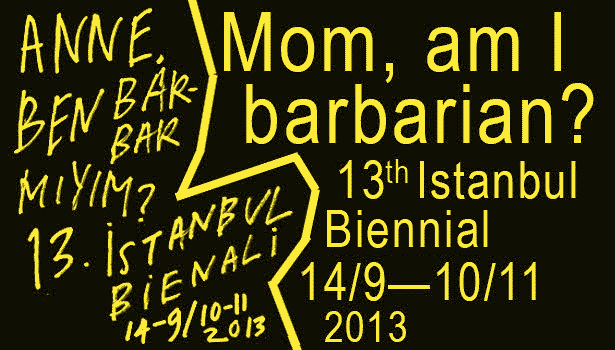

Organised by: Istanbul Foundation for Culture and Arts
The 13th Istanbul Biennial Public Programme titled Public Alchemy examines the ways in which publicness can be reclaimed as an artistic and political tool in the context of global financial imperialism and local social fracture. From February to November 2013, a series of lectures, workshops, seminars, performances and poetry readings will examine how a political, poetic alchemy is at work, both in Turkey and across the world in which conventional concepts of ‘the public’ are being transformed.

Making the city public8–10 February 2013
Venue: Istanbul Technical University, Maçka Campus C101 Conference Hall
Taking the accessibility of civic space and debate over rights to the city as the starting point for our discussion of publicness, the first events of the 13th Istanbul Biennial public programme focus on current urban transformations in Istanbul.
Urban transformation can be understood as a political mechanism the role of which is not only to produce the way in which a city is designed aesthetically and technically but also the way in which its citizens are produced as actors—where and how we live, where and how we work, where and how we socialize. Current urban transformations in Istanbul in which historically and culturally diverse neighbourhoods are being destroyed to make way for newly privatized housing, in which shopping malls are replacing local markets, and in which central areas of social gathering are being relocated to the perimeters of the city, form part of a state-scale rebranding mechanism intended to attract global investment. Such changes intervene in an already complex landscape, wherein layers of competing political and cultural history reveal traces of multifaceted concepts of public space from the Imperial to the Republican, from the informal to the formal. But what is the future of the city for its subjects—those included and excluded by new architectural legislation, those allowed to stay, and those made, once again, barbarian? In this series of events we seek to question the modus operandi of this transformation and the role of the cultural industries within it.

Friday 8 February 20136:30pm: Introduction: Fulya Erdemci & Andrea Phillips
6:45pm: Poetry reading: Lale Müldür (poet)
7pm: Lecture: Teddy Cruz (architect, Professor in Public Culture and Urbanism in the Visual Arts Department at University of California, San Diego, co-founder of CUE/Center for Urban Ecologies)
“Where is Our Collective Imagination? Architecture and the Crisis of the Public”
8:30pm: Improvisation: Cevdet Erek (artist and musician, Lecturer at ITU TM Conservatory and Architecture Faculty)

Saturday 9 February 20132pm: Lecture illustrated by hand: Christoph Schäfer (Conceptual artist, sparkling draughtsman, educational ntertainer, urban writer and uninvited city planner)
“A Machine of Possibilities: the urban turn, art and the right to the city”
3:30pm: Panel discussion: “Agoraphobia: urban transformation in Istanbul” with
Betül Tanbay (Taksim Platform, academician)
Yaşar Adnan Adanalı (development planner, researcher, blogging at reclaimistanbul.com and mutlukent.wordpress.com)
Sedat Doğan (Association of Struggle Against Capitalism, writer at adilmedya.com)
İlhan Tekeli (city and regional planner, social scientist)
Erbay Yucak (legal advisor)
Chair: Fulya Erdemci

Sunday 10 February 2013
10–2pm: Tour to North-West Istanbul urban transformation areas with Jean-François Perouse (social geographer)
“Towards the emerging peripheries of North-West Istanbul: the striking making of the ‘New Istanbul’”
All events will be in English except the Agoraphobia panel discussion and the tour, which will be in Turkish. Simultaneous translation will be available for all events except for the tour.
Future events:
Public Address 22–23 March 2013
Public Capital 10–11 May 2013
Becoming Public Subjects 14–15 September 2013
Future Publics/New Collectives 1–2 November 2013

Sunday, May 27, 2012

Friday, May 25, 2012

Friday, April 20, 2012

Em solidariedade com a es.col.a da Fontinha - Porto

"Depois do despejo, o recheio do EsColA foi destruído e o edifício emparedado, a mando da câmara municipal do Porto.

A operação de despejo teve início cerca das 10h00, com a intervenção de grande força policial. Agentes encapuçados entraram no Es.Col.A, rebentando o gradeamento. Vários outros agentes e dez carrinhas de força de intervenção e outros tantos carros policiais bloquearam o acesso ao bairro. 
Ainda no exterior, foram detidos dois apoiantes do projecto, e, posteriormente, um terceiro. 
Entretanto, os ocupantes do edifício foram levados para o exterior pelas forças policiais, juntando-se às dezenas de pessoas que ali se concentravam. Juntos, num sitting de resistência não violenta, tentaram impedir a saída das carrinhas policiais. O momento gerou bastante confusão, com registos de violência por parte das forças de intervenção. As carrinhas acabaram por passar, mantendo-se um cordão policial a bloquear o bairro. 
Entretanto, as cerca 150 pessoas presentes estiveram reunidas no Largo da Fontinha. A assembleia improvisada decidiu rumar até à esquadra do Heroísmo, em solidariedade com os três detidos que ali se encontravam, e que entretanto foram deslocados para a esquadra da Bela Vista, estando previsto que irão a julgamento ao início da tarde. 
O pessoal partiu depois até às traseiras da câmara municipal do Porto. O edifício camarário encontra-se gradeado e "protegido" por um cordão de agentes policiais.

Alegadamente por razões de segurança, uma vez que um dos apoiantes foi detido pela polícia após se regar com gasolina, a Polícia chamou os bombeiros para "limparem" o local. Os manifestantes rumaram para frente ao edifício da câmara municipal. O apoiante que se regou com gasolina estará neste momento a ser levado ao hospital, para ser lavado e será depois libertado, segundo fonte policial.

Encontram-se em frente à câmara cerca de de 200 pessoas. [15h00]"

um dos brilhantes cartazes da es.col.a
 

Thursday, December 01, 2011

N30 - London


clown bloc
precarious workers brigade
Goldmiths "Capitalism is Crisis"

Thursday, November 10, 2011

AMIW@VBKÖ – Ou Antes, o que Podem as Palavras? / Or Rather, What Can Words Do? / Oder vielmehr, was können Wörter tun?

Mónica Faria by litcha sparletta
Mónica Faria, a photo by litcha sparletta on Flickr.
AMIW was initiated in 2005 by the artist Carla Cruz to expound the question of gender and to question power relations in the arts. It wants to affirm itself as a political platform; to let go of the desire of belonging to a discriminatory art world in an attempt to figure out new ways of giving account of hu’wo’man art production.

At the VBKÖ AMIW asks together with the ‘3 Marias’ (Maria Isabel Barreno, Maria Teresa Horta, Maria Velho da Costa): “Sisters. What can [art] do? Rather, what can words do?” AMIW thus refers to the conscious "New Portuguese Letters" that addressed the age-old oppression of Portuguese woman and provoked, in 1972, during the Salazar/Caetano dictatorship, the biggest literary scandal of Portugal.

The exhibition shows works by the artists André Alves, Catarina Carneiro de Sousa and Sameiro Oliveira Martins, Laura García and Said Dokins, Alice Geirinhas, Risk Hazekamp, Roberta Lima, Ana Pérez-Quiroga, Suzanne van Rossenberg, Ângelo Ferreira de Sousa, Yan María Yaoyólotl, and performances by André Alves, Stefanie Seibold and the duo Projecto Gentileza.

Moreover, visitors will have access to a documentary presentation of AMIW – 2005/10. In addition at the VBKÖ there will be a video lounge, with: Miguel Bonneville, Mónica Faria, Risk Hazekamp, Anna Jonsson, Cristina Mateus, Rita Rainho, Flávio Rodrigues, Evelin Stermitz and Lenka Vráblíková.

The exhibitors take passion as excuse for engaging the world. At the core of their works they intends to question how the desire for visibility can be transmuted into a different experience one of equality and accountability as to evoke a feminist practices that functions as a ‘counter-hegemonic intervention’ in the arts in particular and in society in general?

http://amiw-vbkoe.blogspot.com/

and

http://allmyindependentwomen.blogspot.com/

Friday, October 21, 2011

about London riots

"A capitalism that is no longer accompanied by an increase in the standard of living, especially of the poorest, loses its credibility." (Boltanski and Chiapello, 2005:513)

Monday, March 28, 2011

Monday, March 21, 2011

007 by carlacruz

Tuesday, March 01, 2011

The Ethics of Encounter Research Workshop

Thursday 3 March & Friday 4 March 2011

As an increasing number of artists site their practice within the social fabric of everyday life, the encounter has been placed at the heart of a newly defined aesthetic experience. Participatory, collaborative, community-based and documentary methodologies which engage directly with interpersonal relations and social realities now proliferate both within and beyond the institution. This move away from traditional forms of representation into the territories of use and action has endowed art’s latest ‘social turn’ with a renewed and expanded ethical significance. In parallel with these developments, it is claimed that ethics has triumphed in the public debate to reign over culture and displace politics.

This research workshop will examine the complex interfaces which have emerged between aesthetics, politics and ethics in the 21st century. Taking into account their historical imbrications in art discourse together with the so-called ‘ethical turn’ of contemporary politics, we aim to develop a critical understanding of their most recent forms and configurations across the diverse terrains of socially-engaged art. The ethical valence of artworks has dominated debates to date – whether interventions into the social fabric can be considered productively ‘good’ or transgressive, ‘bad’ and yet, ultimately, revealing. If the ethical is now a common route for artists seeking to broach the political and provide a site for critique, is it possible to move beyond this dichotomy and map the potential and limits of ethical engagements in art?

The Ethics of Encounter research workshop has been devised as part of a programme of exhibitions, events and residencies of the same name presented at Stills between November 2010 and March 2011. Consecutive exhibitions included lens-based documentary works by The Atlas Group (Lebanon / USA), François Bucher (Columbia / Germany), Renzo Martens (Belgium), Dani Marti (Scotland), Frederick Wiseman (USA) and Artur Żmijewski (Poland). The workshop has been designed to expand the parameters of this curatorial investigation and situate these works in relation to parallel developments within other reality-driven practices. For more information about The Ethics of Encounter programme please visit www.stills.org.

Speakers and interlocutors include Carla Cruz (Goldsmiths University of London), Gail Day (University of Leeds), Angela Dimitrakaki (The University of Edinburgh), Anthony Downey (Sotheby’s Institute of Art), Alana Jelinek (University of Cambridge), Kirsten Lloyd (Stills / The University of Edinburgh), Tracy Mackenna (Duncan of Jordanstone College of Art and Design) & Ken Neil (Glasgow School of Art), Mark Miller (Tate Britain) & Victoria Walsh (Tate Britain), Dominic Paterson (University of Glasgow), Michaela Ross (Chelsea College of Art and Design), Harry Weeks (The University of Edinburgh), Stephen Wright (European School of Visual Arts)


‘Mutirão’ or the Importance of a New Extended Solidarity
This paper draws upon empirical research undertaken within a small community in Brazil. It examines the reclaiming of tools from artistic practice for sustainable development projects.

In 1993 the Brazilian government decided to eradicate Chagas disease in Pernambuco’s State, a disease transmitted to humans by an insect that nests in the local rammed earth houses. With the eviction of the insect, began the history of Vila União (Union Village). Though the government provided the materials, the construction of the new buildings was left to the local population. The women organised themselves into mutirão (collectives) and worked together to build 25 family houses. Since then, the community has grown and the mutirão continues to function in terms of agricultural work and in brick making. However, clean water has not yet arrived, subsistence agriculture is still their main resource, the land remains in the hands of a couple of colonels and education is difficult to access. Under these circumstances several local, national and international organisations have coordinated an ambitious project involving a group of local and foreign artists, filmmakers, NGO workers and residents. In the Summer of 2011 they will come together to renovate the now 72 homes in Vila União, painting and plastering the buildings before going on tp collectively create a visual identity for the village which celebrates the community’s singularity.

The Portuguese Intercultural Movement IDENTIDADES has been working with the region of Conceição das Crioulas, where the community is based, since 2003, and on this project since 2009. Despite the fact that the movement is mainly composed of visual artists, art is never directly mentioned. Vila União Project does not have the support of art institutions; it is not an artwork of an individual or collective, it is not even an art project. Nonetheless we claim to be applying knowledge gained through art practice and believe we will harvest new knowledge for our individual practices. Why then is Vila União Project still relevant for artistic discourse? Why is it not mere politics and social practice? Does positioning such activity within contemporary art discourse jeopardize not only its political effects but also its ethical stance? How does the project sit within the intricate relations between politics and aesthetics? What is its potential for instituting and fostering democracy?

Biography

Born - Vila Real – Portugal 1977.

Currently researching for an MPhil/PhD in art practice at Goldsmiths University of London (since 2009). MFA at the Piet Zwart Institute, Rotterdam, The Netherlands, 2003. Degree in Sculpture from the Faculty of Fine Arts, University of Porto, Portugal 2001.

Member of several national and international art collectives, such as ZOiNA, Caldeira 213, ROOM, CLANITICA, Ateliers Mentol, Switch Metaphors, Identidades, Palindromes and AC.

Manages the blog and exhibition project All My Independent Women on art and gender and the critical blog Porto Público on participation, public space and politics.

“Her work, sometimes strikingly visible, sometimes no more than a rumor, is concerned with the social constructions that we make and reassert every day in the attempt to question and even undermine these constructions, whether these constructions are gender related, about European Identity or even the privatization of the public sphere and the notion of citizenship. The viewer, participant or passer-by is trapped by the anodyne visuals and forms of her work, which usually disguise less innocent content, and pushed to reconsider his values and pre-conceptions with what is presented by her work.”

This statement, written many years ago by my friend Suzanne van Rossenberg, is still the best rendering of my practice.

Friday, December 10, 2010

Parliament Square Protest London 9.12.10 was also about this...


why did it look more dramatic on the news than it actually was?


merry x-mas!

creativity with minor resources, great impact


a friendly atmosphere prevailed, even after dark when the toughest confronts were taking place,


within a few minutes a group of students started a cafeteria...

Sometimes is difficult not to loose reason


the book bloc


Free counter and web stats